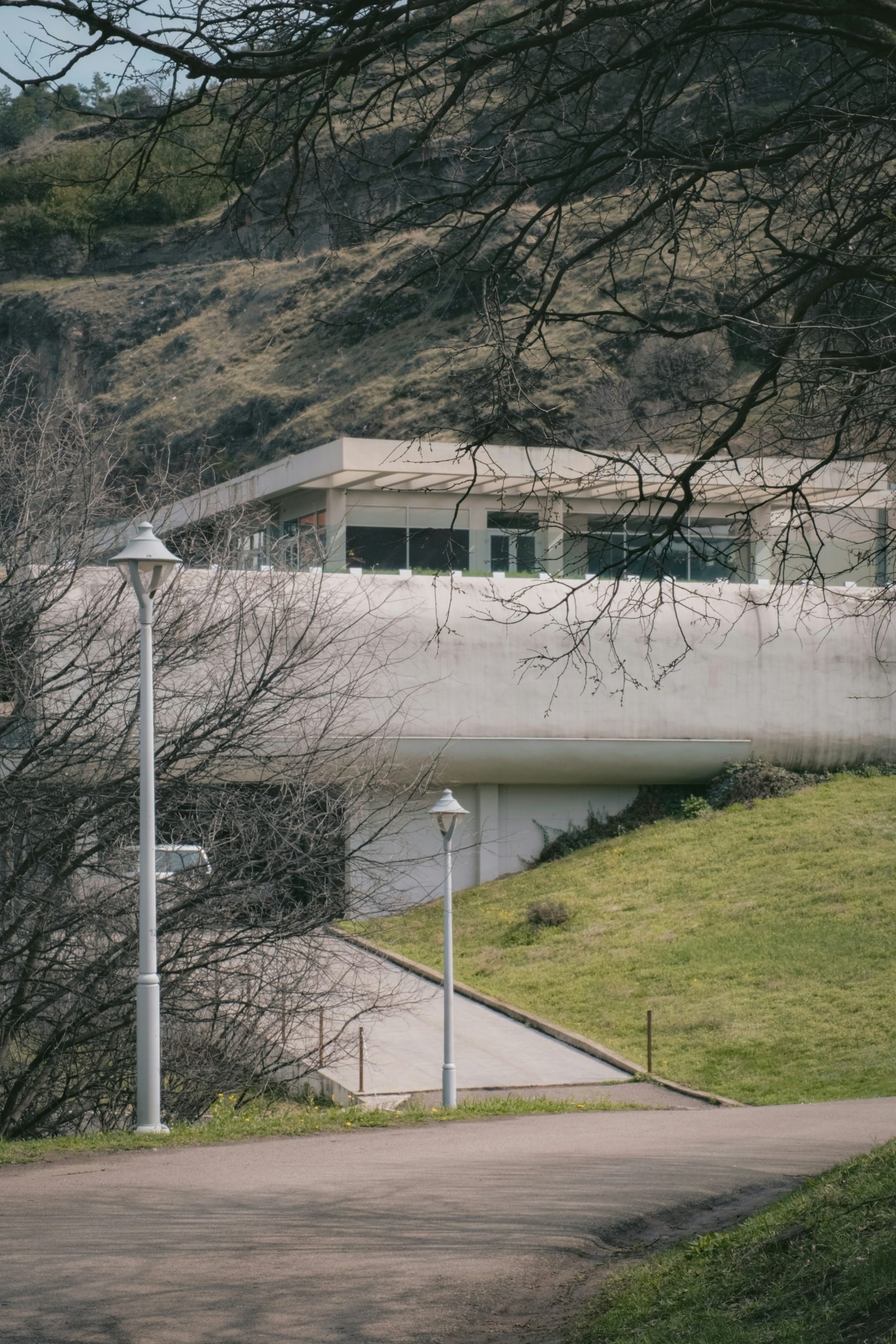
Changes to the structure, windows, utilities, or layout could involve additional requirements. Buyers should investigate these issues before assuming that every proposed improvement will be straightforward.
Preserving the Architecture Could Be the Biggest Challenge
One of the most interesting questions surrounding the property is how much of its original design should remain.
A buyer could attempt to modernize the entire interior, replacing outdated finishes and systems while retaining the curved walls, distinctive windows, and cylindrical tower.
That approach could preserve the features that make the building recognizable while making it more practical for everyday living.
However, a conventional renovation might also remove some of the details that give the house its identity.
The challenge would be finding a balance between preservation and functionality.
For example, custom cabinetry could follow the curves of the walls rather than forcing standard rectangular units into spaces where they do not fit. Lighting could emphasize the original geometry, while modern insulation and climate-control systems could improve comfort without unnecessarily changing the building’s appearance.
The result could be a striking residence that combines older architectural ideas with modern living standards.
But achieving that result would require more than imagination. It would take careful planning, experienced contractors, and a realistic budget.
Who Might Be Interested in a Property Like This?
A house with such an unusual design is unlikely to appeal to every buyer.
Someone searching for a conventional family home may prefer a property that needs only cosmetic improvements. A buyer with limited renovation experience might find the uncertainty surrounding this building overwhelming.
However, a few types of buyers could find its unusual features appealing.
Architecture enthusiasts might appreciate the opportunity to preserve a design that stands apart from ordinary residential construction.
Experienced renovators could see potential in a property that needs substantial work, provided the structure and financial calculations make sense.
Creative professionals might be interested in the spacious interior and distinctive natural lighting, although any alternative use would depend on local zoning and building regulations.
Buyers seeking a one-of-a-kind residence could value the opportunity to create a home that would be difficult to reproduce elsewhere.
Even for these buyers, enthusiasm should come after a thorough inspection—not before it.
The Difference Between a Renovation Opportunity and a Financial Trap
The debate surrounding this house comes down to one fundamental question: Is the unusual architecture worth the investment required to restore it?
There is no answer based on the asking price alone.
If the foundation, roof, structure, windows, and essential systems are in reasonable condition, the project might be more manageable than its unfinished appearance suggests.
If major structural problems, water damage, or extensive utility replacement are discovered, however, the total cost could rise dramatically.
A detailed inspection and independent renovation estimates would be essential before making an offer.
Buyers should also compare the likely completed value of the property with the combined cost of purchasing and renovating it. An expensive restoration does not automatically create a valuable home, particularly when the architecture may appeal to a relatively small group of potential buyers.
That is why the property’s unusual appearance is both an advantage and a potential complication.
Its individuality makes it memorable, but it may also make future maintenance and resale more challenging.
A Forgotten Architectural Vision Waiting for Its Next Chapter
There is something compelling about a building that refuses to look ordinary.
The house on the hillside appears to represent an ambitious architectural idea, with curved glass, rounded spaces, and a tower-like structure that gives it a distinctive silhouette.
Its reported $65,000 asking price makes the opportunity sound tempting, but the unfinished interior and possible renovation requirements add considerable uncertainty.
For one person, it may be an impractical structure that would cost too much to restore. For another, it could be a rare chance to preserve an unusual home and give it a completely new life.
The most important thing is not whether the property looks impressive in photographs. It is whether its underlying condition, renovation requirements, and eventual value make financial sense.
Until those questions are answered, the house remains an intriguing architectural question mark on the hillside.
