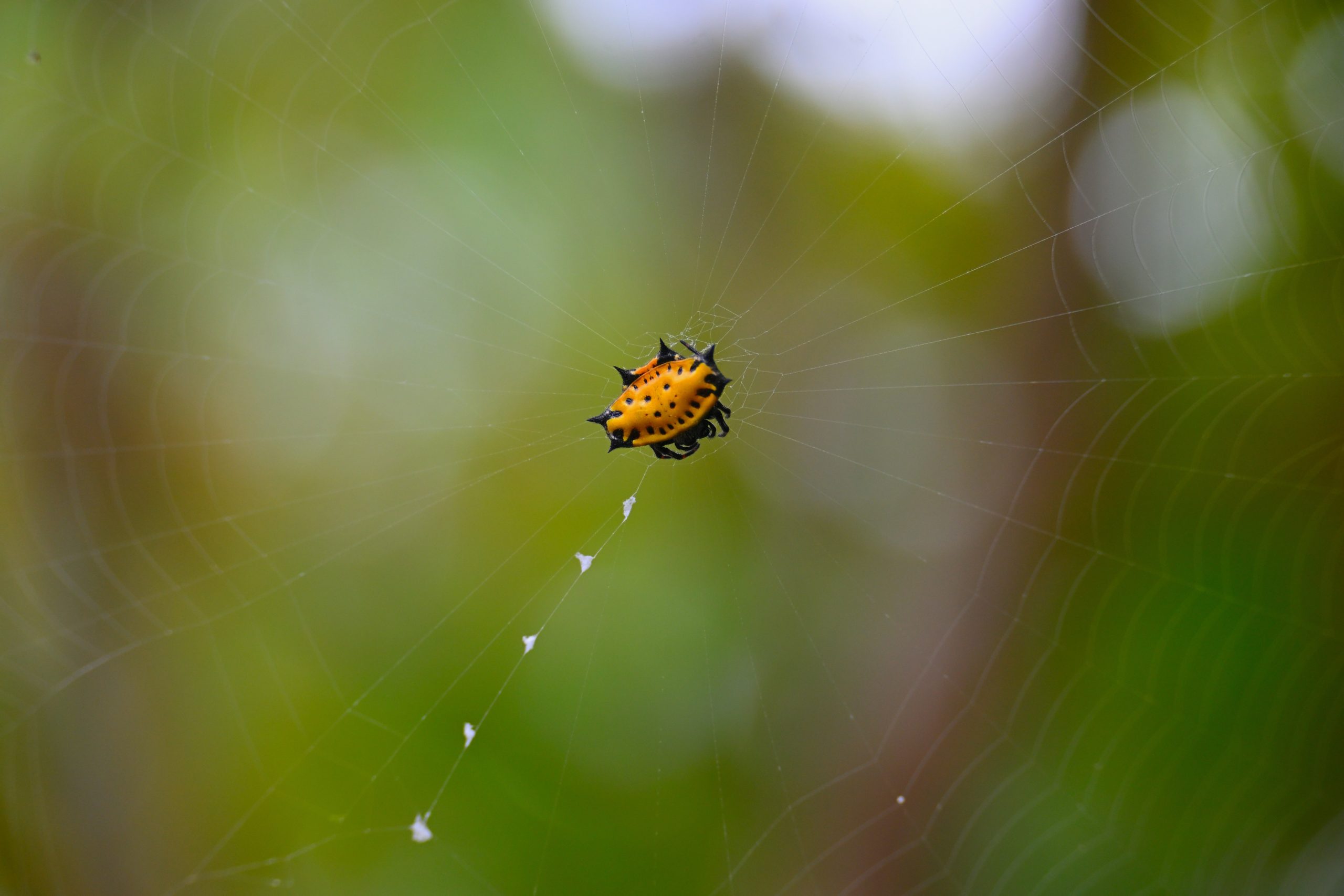
Orb-weaver spiders are named after the circular webs they construct to capture flying insects. These webs are among the most recognizable structures in the natural world.
A typical orb web consists of several supporting strands, radial lines extending outward from a central area, and a spiral section that helps capture prey.
The spider produces silk from specialized glands and releases it through structures called spinnerets. Different types of silk can have different mechanical properties, allowing the spider to create strong supporting threads and more flexible sections.
Building a web requires coordination and an impressive sequence of movements.
The spider must establish attachment points, create supporting lines, construct radial strands, and complete the capture spiral. Although the finished web may appear delicate, its construction is a highly specialized biological process.
Once the web is complete, the spider often waits for prey to become trapped.
Vibrations travel through the silk when an insect struggles. These vibrations provide information about the location of the prey, allowing the spider to respond without constantly moving around its web.
For a small creature, this is an extraordinarily effective hunting strategy.
It also explains why an orb-weaver may remain motionless for long periods. Waiting is part of its normal behavior, not necessarily a sign that it is sick, dead, or preparing to attack.
Why Do Spiny Orb-Weavers Sometimes Appear Around Homes?
Finding an unusual spider on a garage wall can make it seem as though the animal has deliberately entered the home.
In reality, spiders often appear near human structures because these environments can provide suitable conditions for survival.
Garages, sheds, porches, and outdoor walls may offer:
- Protected areas away from strong winds and heavy rain.
- Convenient surfaces for attaching silk threads.
- Nearby insects attracted to outdoor lighting.
- Quiet corners with limited human activity.
- Places where a spider can remain relatively undisturbed.
Outdoor lights can be particularly important because they attract flying insects. Where insects gather, spiders may find opportunities to feed.
However, seeing a spiny orb-weaver indoors does not necessarily mean there is an infestation or that the home has a larger pest problem.
Many spiders are solitary, and finding one individual is not evidence that dozens more are hiding nearby.
It is also worth remembering that not every spider with a spiny abdomen belongs to the same species. Several unrelated spiders can have unusual body shapes, and identification requires more than simply noticing a yellow color or pointed projections.
Geographic location matters, too. Different spiny orb-weaver species are found in different parts of the world, so a photograph should always be considered alongside where the animal was discovered.
Should You Leave a Spiny Orb-Weaver Alone?
For many people, the instinctive reaction to finding an unfamiliar spider is to remove it immediately.
That response is understandable. Not everyone feels comfortable sharing a home or garage with an eight-legged visitor, especially one with such an unusual appearance.
But if the spider is identified as a harmless orb-weaver and is located somewhere it does not interfere with daily activities, leaving it undisturbed can be a reasonable choice.
Spiders play an important role in natural ecosystems by feeding on insects. Orb-weavers, in particular, help capture flying insects that become trapped in their webs.
They are part of a much larger food web and can themselves become prey for birds, wasps, and other animals.
If the spider is outside or in a quiet corner of a garage, there may be little reason to disturb it.
If it is located somewhere people regularly walk, reach, or store equipment, relocating it may be more practical.
The key is to avoid unnecessary contact and to make sure the identification is reasonably reliable before deciding how to handle it.
