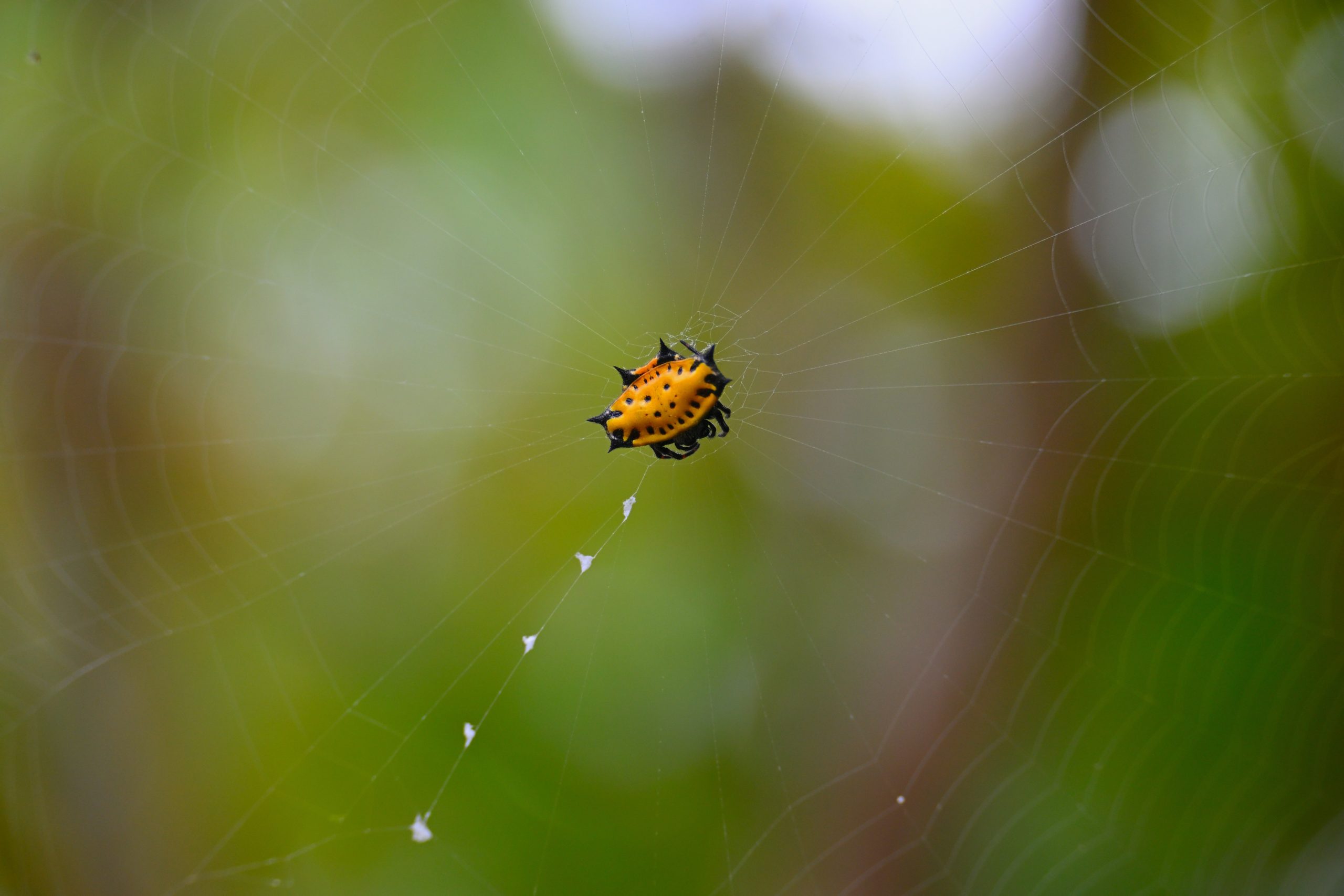
Unlike the smooth, rounded abdomen of many familiar spiders, these species possess a hardened outer structure with several projections extending from its edges.
In some species, six prominent spines are particularly noticeable.
At first glance, these structures resemble miniature weapons. Their pointed appearance naturally encourages people to wonder whether they are used for attacking predators or defending the spider.
However, their function is more complicated than simply serving as weapons.
Researchers have proposed that the unusual abdominal shape and spines may help make these spiders more difficult for predators to handle or swallow. Their rigid structures can also contribute to the spider’s distinctive body form.
The exact defensive value of these features may vary among species, and it would be misleading to assume that every spine has one clearly established purpose.
What is clear is that these structures are part of the spider’s natural anatomy, not evidence of an aggressive nature.
The spider does not need to chase, threaten, or confront humans to survive. Its daily activities revolve around building and maintaining its web, capturing small insects, and avoiding predators.
Is a Yellow Spiny Orb-Weaver Dangerous to Humans?
This is probably the first question most people ask when they discover an unfamiliar spider inside or around their home.
The good news is that spiny orb-weavers are generally considered harmless to people.
They are not known for aggressive behavior, and they typically prefer to remain on their webs rather than interact with humans.
Like other spiders, they may bite if handled, trapped against the skin, or threatened. However, bites from these spiders are not generally considered medically significant.
Their dramatic appearance should not be confused with a dangerous level of venom.
Spiders use venom primarily to subdue their prey, usually small insects. The presence of venom does not automatically mean a spider poses a serious threat to humans.
Nevertheless, it is sensible to avoid handling any unfamiliar spider with bare hands.
If one appears inside a garage, shed, or other part of a home, observing it from a safe distance is usually the best first step. If it needs to be moved, a container and a piece of stiff paper can sometimes be used to relocate it safely, provided the spider can be approached without direct contact.
If someone is bitten and develops severe pain, spreading swelling, breathing difficulties, or other concerning symptoms, medical advice should be sought promptly. Difficulty breathing or signs of a serious allergic reaction require emergency assistance.
The important distinction is that an unusual-looking spider is not automatically a dangerous one.
Why Is Its Body Such a Bright Yellow?
The bright coloration of some spiny orb-weavers is another feature that makes them so memorable.
Yellow, orange, red, and black patterns are common across many insect and spider species. These colors can serve different biological purposes, depending on the animal and its environment.
In some cases, conspicuous coloration may contribute to warning signals or influence how predators perceive an animal. In other situations, coloration may simply be part of a species’ inherited physical characteristics.
For spiny orb-weavers, it is important not to assume that every brightly colored individual is displaying a warning specifically intended for humans or that its color necessarily indicates toxicity.
The yellow-and-black combination can look almost artificial, but it is a natural variation found in certain species.
Their markings also help distinguish different species and populations. Even spiders belonging to the same genus can look surprisingly different.
This is one reason photographs of spiny orb-weavers often attract attention online. Their unusual shapes and vivid patterns make them easy to mistake for creatures that belong in a much stranger world.
The Remarkable Web-Building Skills of Orb-Weavers
While their appearance attracts attention, their web-building abilities may be even more impressive.
