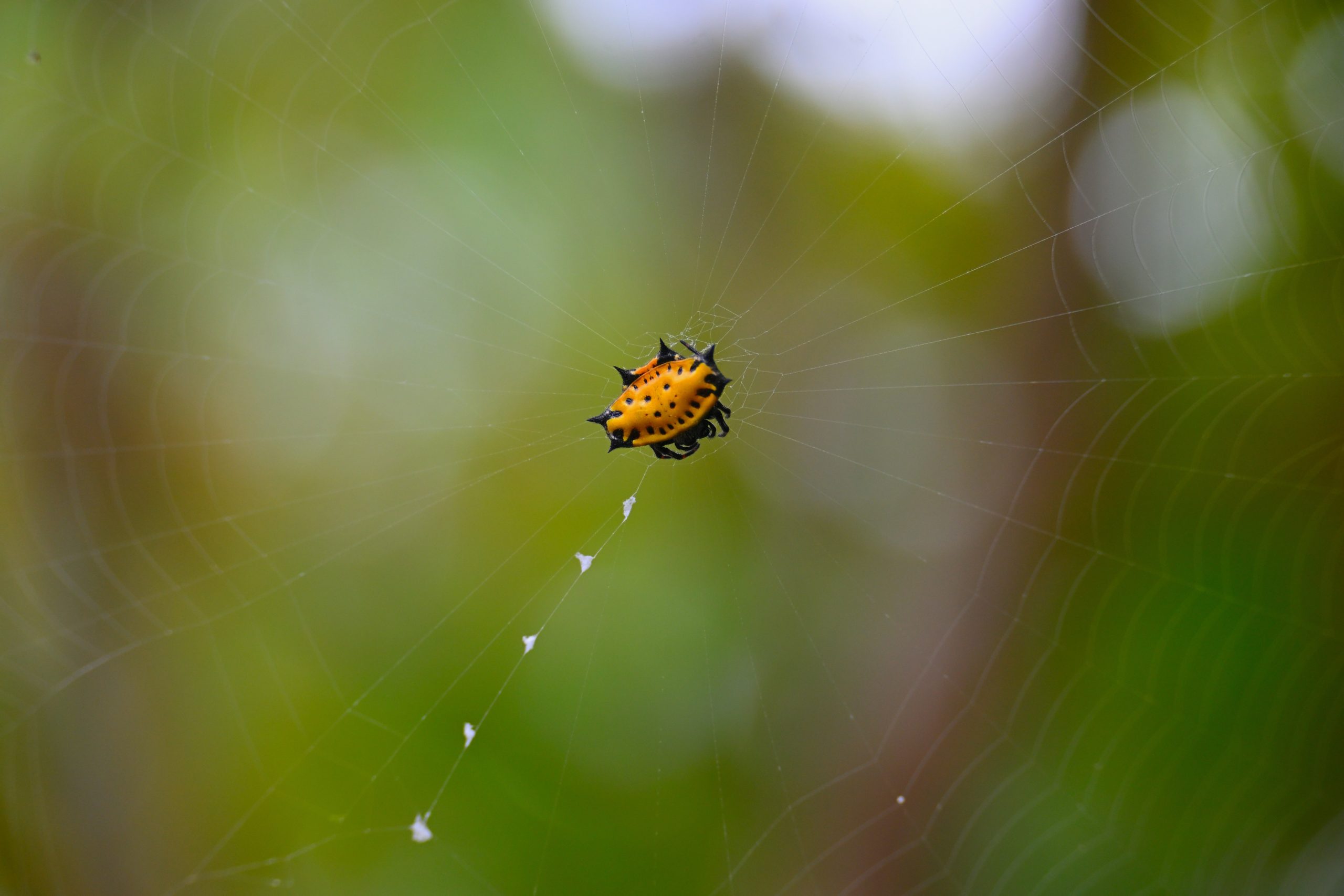
Sometimes, the most surprising encounters happen in places we rarely think twice about. A garage, a garden shed, or a quiet corner of the house can suddenly become the setting for an unexpected discovery. And when that discovery involves an unfamiliar creature with bright colors, unusual markings, and sharp-looking spines, curiosity can quickly give way to fear.
That was exactly what happened during one unexpected encounter with a small spider clinging to a garage wall. At first, its appearance was almost alarming. Its brilliant yellow body, neatly arranged black spots, and several long projections extending from its sides made it look less like an ordinary spider and more like something from a science-fiction movie.
It was difficult to know what to make of it. Was it dangerous? Was it poisonous? And why did it look so different from the spiders most people encounter around their homes?
After taking a closer look and researching its unusual appearance, the mystery began to disappear. The creature appeared to belong to the genus Gasteracantha, commonly known as spiny orb-weavers. These remarkable spiders are known for their distinctive body shapes, decorative-looking spines, and impressive ability to construct intricate webs.
What initially seemed frightening turned into an opportunity to discover one of nature’s more unusual designs.
A Spider That Looks Almost Too Unusual to Be Real
Most people are familiar with the general appearance of a spider. They expect eight legs, a relatively small body, and perhaps a web stretched between two objects. But certain species look nothing like the familiar spiders found in basements, gardens, or household corners.
Spiny orb-weavers are among them.
Members of the Gasteracantha genus have unusually shaped abdomens, often with hard-looking projections extending outward. Depending on the species, these spines can be short, curved, or noticeably elongated.
Their bodies may also feature contrasting colors, including yellow, white, orange, red, and black. Some species have striking patterns that make them immediately recognizable.
The combination can be surprising, particularly for someone who has never encountered one before.
A bright yellow abdomen covered in black spots, for example, creates a dramatic contrast. When several pointed spines extend from the sides, the spider can appear much larger and more threatening than its actual size suggests.
Yet its unusual appearance is not evidence that it is preparing to attack.
Like many other spiders, spiny orb-weavers have physical characteristics that developed through evolution and serve functions in their natural environment. Their bodies are specialized for a particular way of life, rather than designed to frighten humans.
What Exactly Is a Spiny Orb-Weaver?
The name Gasteracantha refers to a genus of spiders belonging to the family Araneidae, commonly called orb-weaver spiders.
Orb-weavers are particularly well known for constructing circular or spiral-shaped webs. These structures often appear as delicate geometric patterns stretched between branches, plants, fences, or other surfaces.
The webs are not simply decorative. They are sophisticated hunting structures designed to capture flying insects.
When an insect becomes trapped in the sticky strands, the spider can detect the vibrations traveling through the web. It then moves toward the captured prey and uses its specialized mouthparts to feed.
Spiny orb-weavers follow this general hunting strategy, although their distinctive body shapes make them stand out from many other members of the orb-weaver family.
There are multiple species within the Gasteracantha genus, and their appearance varies considerably. Some have broad, rounded abdomens with several prominent spines, while others display different combinations of colors and markings.
This is why identifying a spider from a description alone can be difficult.
Even when a photograph appears to match a particular species, details such as geographic location, body shape, spine arrangement, and coloration can make a significant difference.
Why Does This Spider Have Six Sharp-Looking Spines?
Perhaps the most unusual feature of a spiny orb-weaver is its abdomen.
