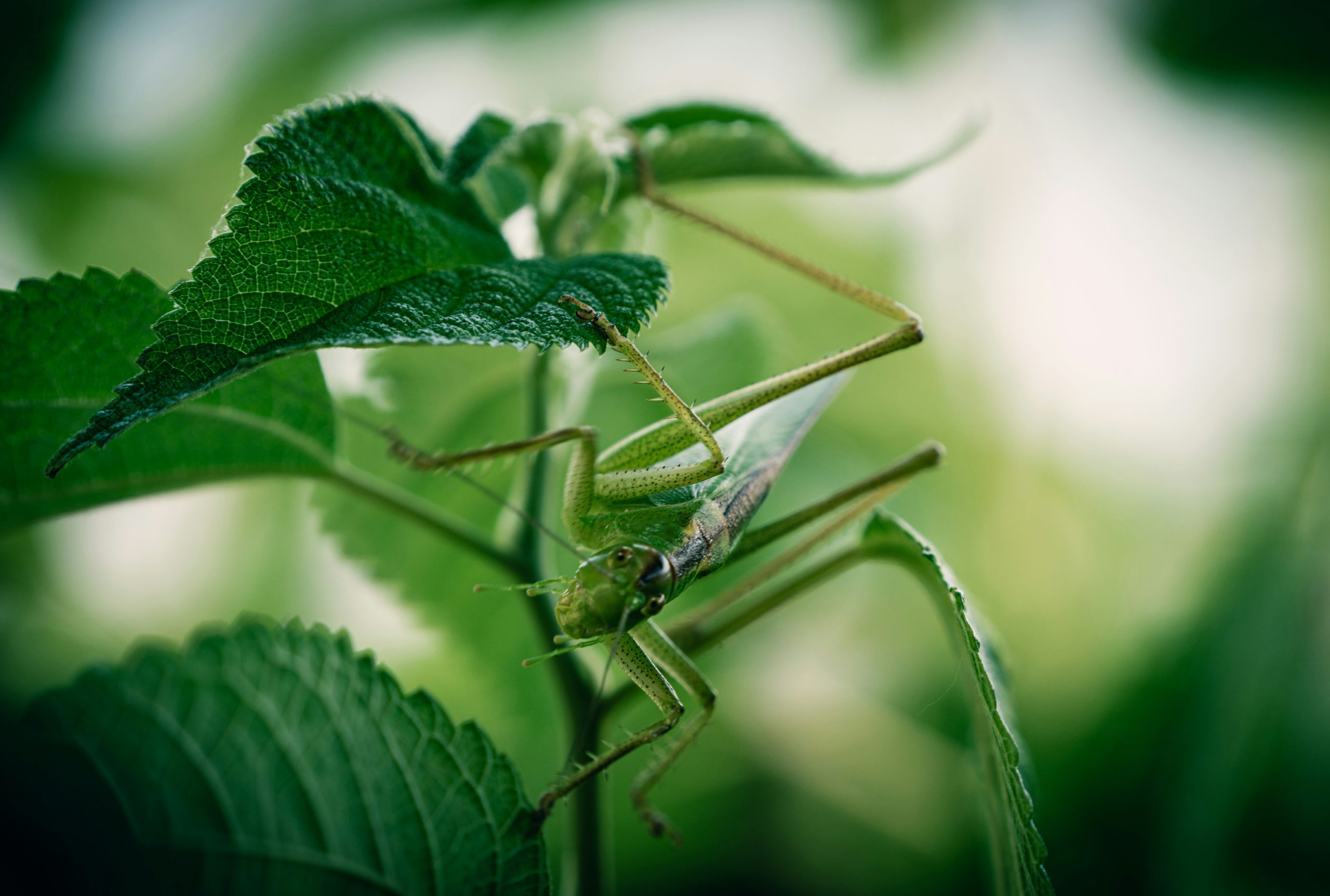
Mantises are predators that feed on other insects and arthropods. Depending on their species and size, their prey may include flies, moths, crickets, aphids, caterpillars, and other small animals.
Their presence can contribute to the natural activity taking place in a garden. Rather than relying entirely on chemical treatments to manage insects, gardeners can benefit from maintaining a habitat that supports a variety of organisms.
However, praying mantises are not selective pest-control specialists.
They do not distinguish between insects that damage plants and those that provide useful ecological services. They may catch pollinators, beneficial insects, and other predators, too. Their overall effect on garden pests can vary according to the species involved, the availability of prey, and the surrounding ecosystem.
For that reason, it would be misleading to treat mantises as a complete solution to garden pest problems.
Their presence is better understood as one part of a larger ecological picture.
Healthy gardens contain a range of insects, spiders, birds, and other organisms that interact in complex ways. Encouraging biodiversity can support this balance, even though no single predator controls every unwanted insect.
Seeing a group of young mantises emerge close to home offers a reminder that these relationships are happening constantly, often without attracting much attention.
Why the Hatchlings Are So Vulnerable
For all their fascinating adaptations, newly hatched praying mantises face considerable danger.
Their small size makes them vulnerable to birds, spiders, ants, and other predators. Changes in temperature, dehydration, and unsuitable habitat can also affect their chances of survival.
Even a seemingly minor disturbance can create a risk. A person walking across the area may accidentally crush a hatchling, while routine garden maintenance can damage the plants and surfaces the insects use for shelter.
Some young mantises may also fall victim to cannibalism, a behavior known in many mantis species. The likelihood of this happening depends on circumstances such as food availability, density, and the species involved.
Their dispersal is therefore more than a curious sight. Moving away from the hatching site allows the young insects to explore new areas and potentially find better opportunities for food and shelter.
The numbers emerging from an egg case may seem astonishing, but producing many young does not mean that all—or even most—will survive.
Nature’s life cycles often involve substantial losses at early stages. The individuals that make it through these challenges may eventually mature, reproduce, and contribute to another generation.
The tiny insects crossing a doorstep are at the very beginning of that uncertain journey.
What Should You Do If You Find Baby Praying Mantises Near Your Home?
If you discover newly hatched praying mantises around your entrance, garden, or patio, the simplest response is usually the best: observe them without disturbing them.
Here are a few practical steps that can help.
Avoid touching the hatchlings unnecessarily
Their small bodies and delicate legs can be injured by rough handling. Watching them from a short distance allows you to appreciate the event without creating an additional hazard.
If one is in immediate danger, such as directly beneath a door that must be opened or closed, take care to avoid crushing it. Moving it is not always necessary, particularly if it can safely disperse on its own.
Check nearby surfaces for an egg case
An ootheca may be attached to a fence, wall, plant stem, or another sheltered surface nearby. It can resemble a small, hardened, ridged mass.
If you find one and it is not causing a problem, leaving it in place is generally the least disruptive option.
Avoid removing or relocating an egg case simply because it looks unusual. If it must be moved for a practical reason, the appropriate approach can depend on the species and the stage of development.
Be careful with pesticides
Insecticides can harm praying mantises as well as the insects a gardener intends to control. Direct exposure and contaminated surfaces may pose risks, depending on the chemical and how it is applied.
