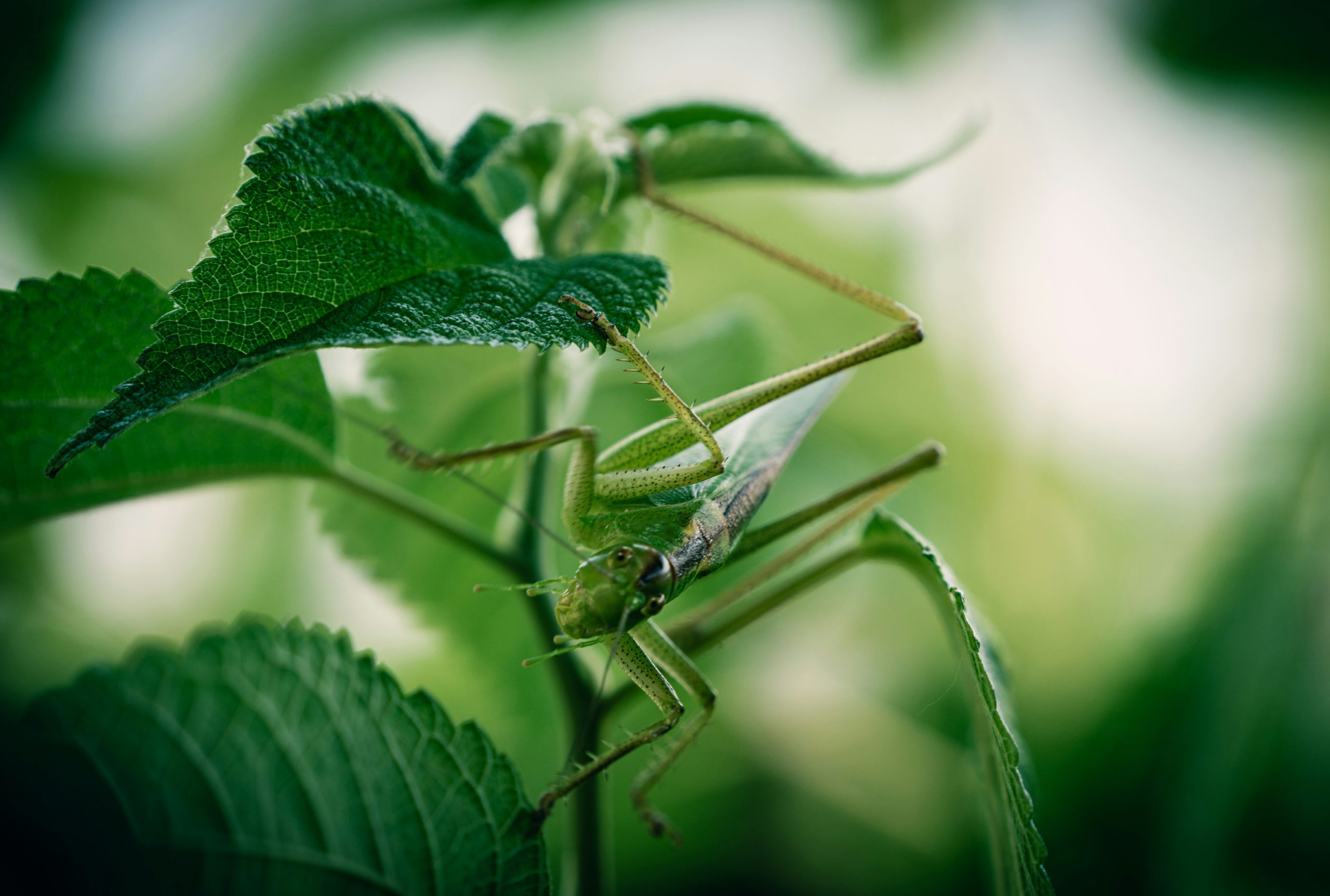
The familiar posture that gives praying mantises their name can make them look as though they are standing with their hands together. In reality, the position is part of an effective hunting adaptation.
Even at an early stage, the basic structure is already there. The hatchlings do not need to learn from a parent how to position their forelegs or stalk prey. Their behavior develops through a combination of inherited instincts, growth, and experience.
Watching them move across a doorstep offers a close look at the beginning of that process.
Why They Scatter in Different Directions
One of the most striking aspects of a mass hatching is the way the young mantises disperse.
Some climb upward. Others move sideways across a wall or descend toward the ground. Those that reach nearby vegetation may disappear among leaves and stems, becoming difficult to distinguish from the surrounding surfaces.
It can look almost choreographed, as though every hatchling knows exactly where it needs to go.
But their movements should not be mistaken for a coordinated group effort. Praying mantises generally live solitary lives, and newly hatched individuals do not normally travel as a unified colony.
Instead, each hatchling responds to its immediate surroundings. Light, contact with surfaces, air movement, and other environmental cues can influence its movement. Once separated from the egg case, each young mantis must find its own way through the environment.
Their dispersal also helps spread individuals across a wider area rather than leaving every hatchling concentrated in one place.
This matters because the first days of life are especially dangerous. A young mantis that remains close to its siblings may encounter competition for food, while one that reaches suitable vegetation may have a better chance of finding small prey and avoiding predators.
There is no guarantee of survival, however. Many hatchlings will never reach adulthood.
That is one of the realities of life in the natural world: an extraordinary number of young can emerge from a single egg case, but only a portion will survive the hazards ahead.
The Surprising Hunting Skills of a Praying Mantis
Praying mantises are widely recognized for their unusual appearance, but their hunting behavior is what makes them especially fascinating.
Unlike insects that actively chase prey over long distances, many mantises rely heavily on camouflage and ambush. They remain still, sometimes for extended periods, waiting for a suitable insect to come within reach.
When the opportunity arrives, the mantis can extend its specialized forelegs rapidly and seize its target.
The spines along those legs help prevent prey from escaping. Once captured, the insect is held firmly while the mantis begins feeding.
This strategy depends on patience, positioning, and the ability to detect movement. The mantis’s body shape and coloration can help it blend into leaves, stems, and other parts of its surroundings.
Its eyes are another important adaptation.
Praying mantises have large compound eyes that provide a broad view of their environment. They also possess a specialized form of binocular vision that helps them judge distance, an unusual ability among insects.
That visual system supports their hunting style. Rather than simply reacting to every movement, a mantis can use visual information to help determine whether an object is close enough to capture.
The tiny hatchlings on a doorstep may not yet be capable of catching the same prey as larger individuals. Their small size limits what they can handle, and their hunting abilities develop as they grow.
Still, the basic equipment is already present. Over successive developmental stages, they will become more capable hunters.
Do Praying Mantises Help Gardens?
For people who enjoy gardening, the appearance of praying mantises can seem like good news.
