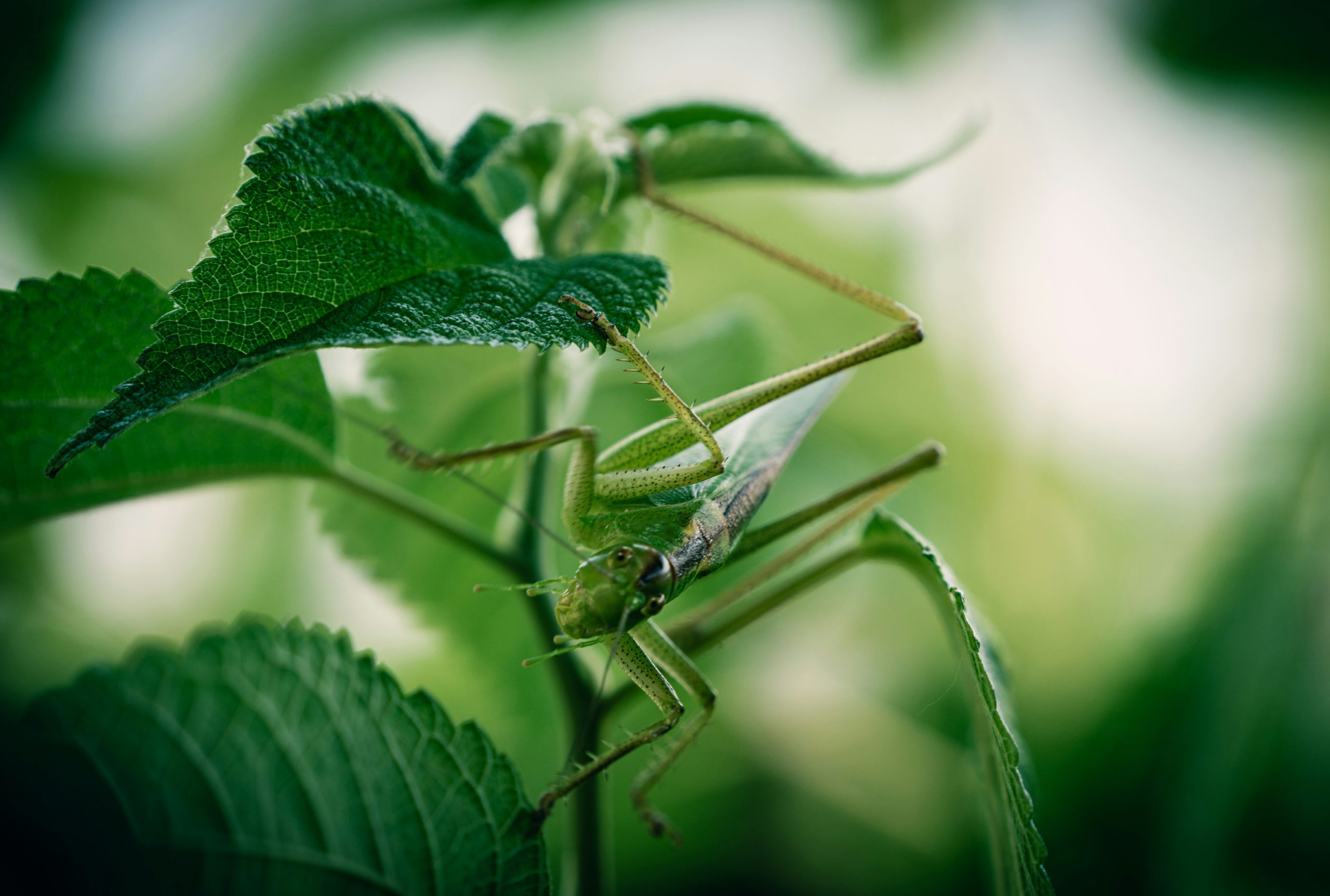
If you discover hatchlings, avoid spraying the immediate area unnecessarily. Follow all product-label instructions and consider nonchemical approaches when managing garden pests.
Leave suitable vegetation undisturbed
Plants, shrubs, and other vegetation provide places for young mantises to hide and search for prey.
A garden with a variety of plant structures can offer more habitat than a space that has been stripped of nearly all vegetation. Avoiding unnecessary disturbance gives small wildlife a better opportunity to move through the area.
Keep children and pets from trampling the group
Young mantises can be difficult to see against soil, brickwork, or fallen leaves. If many are gathered around a doorway, a brief warning to family members can help prevent accidental damage.
There is usually no need to panic or treat the hatchlings as a dangerous infestation. Praying mantises are not known for attacking people, and they do not pose the same concerns as many household pests.
A little awareness can be enough to let the insects continue their natural development.
How Praying Mantises Grow Into Adults
The hatchlings that survive will undergo a series of developmental stages before reaching adulthood.
Praying mantises have an incomplete metamorphosis, meaning they do not pass through a pupal stage like butterflies. Instead, young mantises resemble smaller versions of adults and grow through successive molts.
During a molt, the insect sheds its old exoskeleton so that its body can grow. The new outer covering is initially soft, leaving the mantis temporarily vulnerable until it hardens.
Each developmental stage brings changes in size and maturity. The young mantis gradually develops the characteristics associated with an adult, although the number of molts and the time required vary by species and environmental conditions.
Temperature, food availability, and other factors can influence how quickly development proceeds.
Eventually, surviving individuals reach adulthood and may reproduce, beginning the cycle again.
The process is easy to overlook because much of it takes place in vegetation, where the insects blend into their surroundings. A hatchling that is obvious on a bare doorstep may become almost impossible to find once it reaches a leafy plant.
That transformation makes the first sighting particularly memorable. The insects are visible for a brief period, but they will not remain clustered in the same place for long.
The Meaning People Find in Praying Mantises
Beyond their biological characteristics, praying mantises have attracted human attention because of their unusual posture and deliberate movements.
Their folded forelegs and apparent stillness can make them seem thoughtful or contemplative. It is easy to understand why people have used them as symbols of patience, concentration, and careful observation.
Interpretations vary among cultures and traditions. Some modern symbolic readings associate mantises with mindfulness or good fortune, while particular cultural and religious traditions have their own distinct histories involving the insect.
These interpretations should not be treated as universal beliefs shared by every community. Nor do they replace the biological explanation for the mantis’s behavior.
Still, the symbolism offers an interesting way to reflect on the encounter.
A mantis often appears motionless until it detects an opportunity to act. Its hunting strategy depends on timing rather than constant movement. To a human observer, that behavior can resemble patience, even though it is an adaptation shaped by evolution rather than a conscious philosophy.
Watching newly hatched mantises can invite a similar kind of attention. The scene does not require a dramatic event or a rare destination. It asks only that someone pause long enough to notice what is already happening nearby.
A Small Discovery That Changes the Way You See Your Yard
As the morning continued, the hatchlings gradually disappeared into the surrounding garden.
