“Yes,” I said. “The house belongs to the farm. And the farm belongs to Uncle Randy and Uncle Scott now. They paid us for Dad’s part.”
She was quiet for a long time.
Then she said something that changed the direction of my thinking.
“But Dad’s fields are still here.”
“They are,” I replied.
“I can see them from my window,” she continued. “When he was out planting, I could see the lights going back and forth at night when I was supposed to be asleep. I used to count the passes.”
Then she got up, walked upstairs, and closed her bedroom door.
I remained at the table long after midnight.
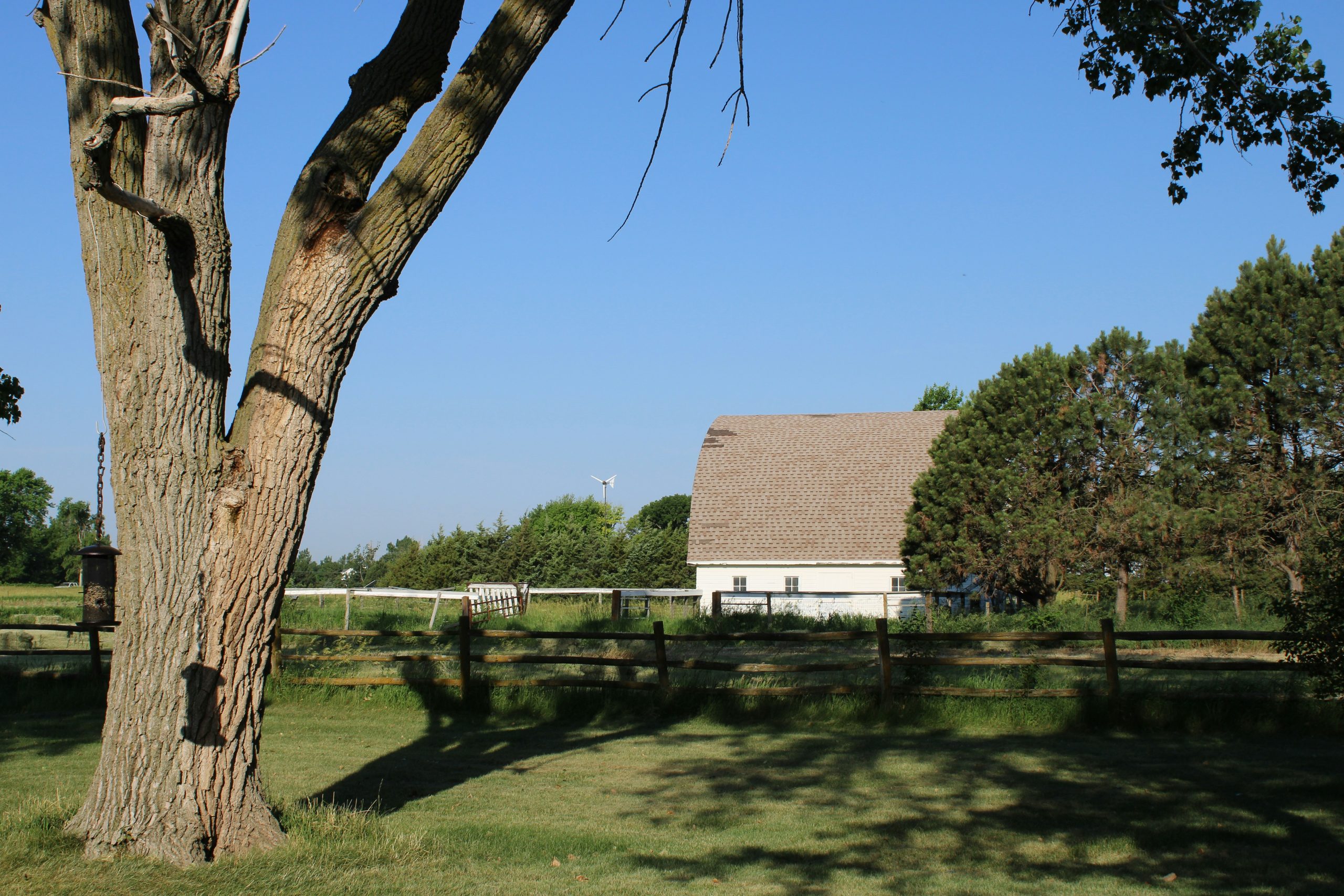
Outside, the yard light illuminated the gravel road that ran past our house. Across it stood the old Wiebe property, an eighty-acre parcel of dryland ground with a small white farmhouse and a leaning red barn.
I had looked at that property countless times over the years.
But that night, I began seeing it differently.
The Eighty Acres Jeff Always Wanted
The Wiebe property had once belonged to Mrs. Wiebe, who lived there alone until she moved into a care center in Red Cloud three years earlier. She died the following August.
Harold Fischer had rented the land for years, but he was seventy-eight and retired after the last harvest. Mrs. Wiebe’s grandchildren, who lived in Lincoln, listed the property for sale in the fall.
It remained unsold.
The farmhouse was old, and neighboring farmers interested in the ground were waiting for the price to fall.
Jeff and I had talked about buying those eighty acres more than once.
We usually discussed it late at night, when the day’s work was finished and there was enough quiet to entertain dreams we knew might never become reality.
“If I ever win the lottery,” Jeff would say, “I’m buying the Wiebe eighty. And I’m giving it to Abby on her eighteenth birthday.”
We never won the lottery.
But as I sat at the kitchen table that night, I realized I might have another way to make his dream possible.
I found a pencil and an old seed-company calendar and turned it over to the blank side.
Dryland ground in our part of Webster County had been selling for approximately $5,000 an acre.
Eighty acres at that price would cost $400,000.
The listing price for the entire Wiebe property, including the farmhouse and barn, had fallen to $430,000.
The buyout check would cover the purchase, leaving me roughly $70,000 before other expenses.
That remaining money would have to cover equipment, seed, fertilizer, and our living expenses until the fall.
It would be tight.
There would be no room for careless spending, and I would have to make decisions that carried real financial risk.
But the property would be mine.
The farmhouse would give Abby and me somewhere to live. The land would give me an opportunity to continue farming. And the fields across the road would remain part of the landscape she had known all her life.
I thought about Jeff’s promise to give those acres to our daughter.
Then I picked up the pencil and began calculating what it would take to make the idea work.
By sunrise, I had made my decision.
The Bank Had No Idea What I Was Planning
The following Monday, I drove to the bank in Hastings.
Kyle Hoffman, the loan officer handling the partnership’s account, came out of his office to meet me. He was a young man in a blue shirt and a tie decorated with little tractors.
He carried the partnership’s file under his arm.

I felt like this story left you hanging. What happened?
Was she successful? Did she hire help? Did her brothers in law fail? Disappointing.