Snow can still scatter that light in many directions.
Because so much light is redirected toward the observer, the surface can remain noticeably brighter than surrounding materials.
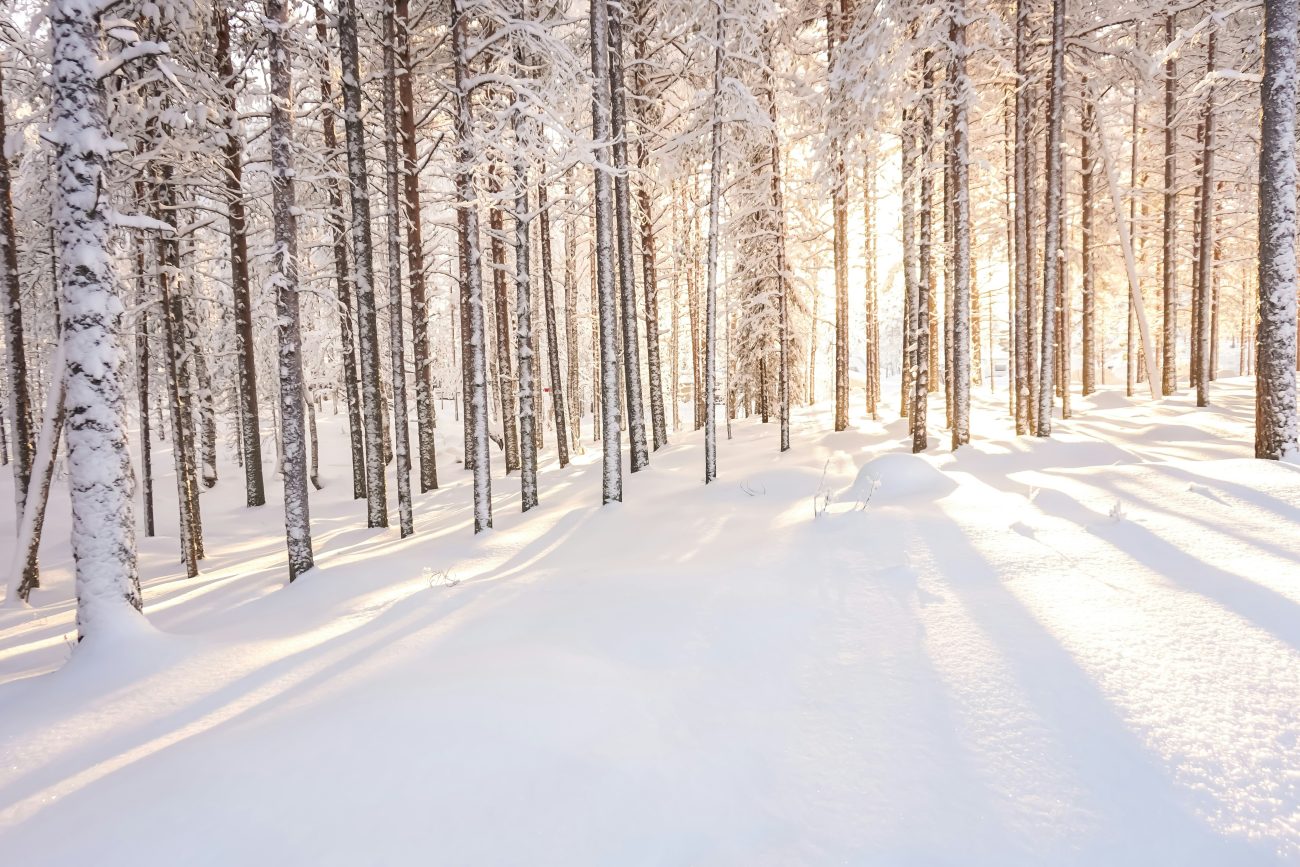
This is also why snow can make a forest look unusually illuminated. Light entering the trees reaches the snow below, and the snow scatters some of that light back upward.
The result can make the underside of branches, tree trunks, and other shaded surfaces easier to see.
However, snow doesn’t create light. It redistributes the light that reaches it.
If there is very little illumination, as on a moonless night far from artificial lighting, snow will not remain brilliantly white. It will appear dark because there is almost no visible light available to scatter toward your eyes.
Does Snow Reflect All Colors Equally?
Not perfectly.
The simple explanation that snow reflects all visible colors together is useful, but the real physics is more complicated.
The optical behavior of snow depends on several factors, including the size of its grains, the amount of liquid water, the presence of impurities, and the wavelength of light.
Clean snow is highly reflective across much of the visible spectrum. That is why it generally appears white.
However, its reflectivity is not identical at every wavelength. The differences become more noticeable in thicker snow, compacted ice, or snow contaminated by particles.
This is also why scientists study snow’s reflectivity, known as albedo.
Albedo describes how much incoming sunlight a surface reflects rather than absorbs.
Fresh snow generally has a high albedo, meaning it reflects a large proportion of the sunlight that reaches it. Darker surfaces, such as exposed soil, asphalt, or vegetation, absorb more energy.
This property has important consequences for the Earth’s climate.
Why Snow Matters to the Earth’s Climate
The white appearance of snow is more than an interesting visual effect. It plays an important role in the planet’s energy balance.
When sunlight reaches a snow-covered landscape, much of it is reflected back toward the atmosphere.
This means the ground absorbs less solar energy than it would if the same area were covered by darker material.
As a result, snow-covered surfaces can remain cooler than nearby areas without snow.
Scientists refer to this relationship as the snow-albedo effect.
When snow melts, darker ground or vegetation becomes exposed. These surfaces absorb more sunlight, which can contribute to additional warming and further melting.
The process can create a feedback loop:
- Rising temperatures cause some snow to melt.
- Darker surfaces become exposed.
- Those surfaces absorb more sunlight.
- The additional absorbed energy can contribute to further warming and snow loss.
This is one reason scientists monitor changes in snow cover in mountain regions, forests, and polar environments.
Snow isn’t simply frozen water sitting on the ground. It is also an important part of the Earth’s climate system.
A Simple Experiment That Shows Why Snow Looks White
You don’t need a laboratory to understand the basic principle behind snow’s appearance.
A simple comparison can help demonstrate how many small surfaces change the way light behaves.
Take a clear glass of water and place it beside a container filled with crushed ice.
Look at both against a dark background.
The water will generally remain transparent because light passes through it with relatively little scattering.
The crushed ice, however, will appear much brighter and more opaque because light encounters many ice-air boundaries.
The comparison isn’t a perfect reproduction of natural snow, but it illustrates the central idea: a material made of transparent components can appear white when its structure causes light to scatter repeatedly.
Snow is an especially effective example because its crystals create an enormous number of tiny optical boundaries.
The Next Time It Snows, Look a Little Closer
The next time you step outside after a snowfall, take a moment to notice the different shades around you.
Look at the bright surface of freshly fallen snow. Compare it with the blue shadows beneath a snowbank. Notice how the landscape changes color when the sun approaches the horizon.
The snow may look like one simple white blanket, but its appearance is the result of several physical processes working together.
Its crystals are mostly transparent. Its structure scatters light. Its depth can influence which wavelengths emerge. And the atmosphere and surrounding landscape can change the colors reflected toward your eyes.
There is no white paint hidden inside a snowflake.
The familiar winter color comes from the way countless tiny crystals interact with light.
Sometimes the most ordinary things in nature are also the most fascinating. Snow is a perfect example: a landscape covered in what appears to be pure white, created not by pigment, but by physics.
