Consider an eagle that stops visiting a familiar feeding area. GPS data may show exactly when the change occurred and where the bird went instead. However, the coordinates alone cannot establish the reason. Scientists may need to examine local habitat conditions, prey populations, weather records, and human activity before drawing conclusions.
This is one of the most important distinctions in wildlife research: tracking can show researchers what an animal did, but additional evidence is often needed to explain why.
Eagles Can Travel Across Remarkable Distances
The movements of some eagle species demonstrate why GPS tracking is so valuable.
A study published in Bird Study examined Eastern Imperial Eagles fitted with satellite tracking devices in Kazakhstan. Researchers followed their movements and found that some birds traveled to wintering areas across the Arabian Peninsula, as well as Iran and India.
The study also found differences between adult and younger birds. The adult eagle included in the research traveled more efficiently than the four younger individuals. Researchers examined how the birds used different landscapes and atmospheric conditions during migration. https://www.usgs.gov/publications/movements-and-landscape-use-eastern-imperial-eagles-aquila-heliaca-central-asia
Such findings help explain why an eagle’s movements cannot always be understood by looking at one region in isolation. A bird that breeds in one country may depend on habitats thousands of miles away during another part of the year.
GPS tracking also helps scientists identify important migration routes and areas where birds may face risks.
If several tracked eagles repeatedly pass through a particular valley or use the same stretch of coastline, that information can help conservation organizations identify locations that deserve closer attention.
How Eagles Manage to Navigate Without Roads or Maps
One of the most fascinating aspects of eagle behavior is their ability to move through complicated landscapes.
Birds do not need roads, signs, or human-made navigation systems to travel between familiar locations. Scientists have studied several mechanisms that may help birds orient themselves, including visual landmarks, the position of the Sun, learned routes, and sensitivity to aspects of the Earth’s magnetic field.
The importance of these mechanisms varies among species and circumstances. Navigation is not necessarily controlled by one simple internal system.
Eagles also have an advantage that makes long-distance travel more efficient: their ability to soar.
The role of rising air currents
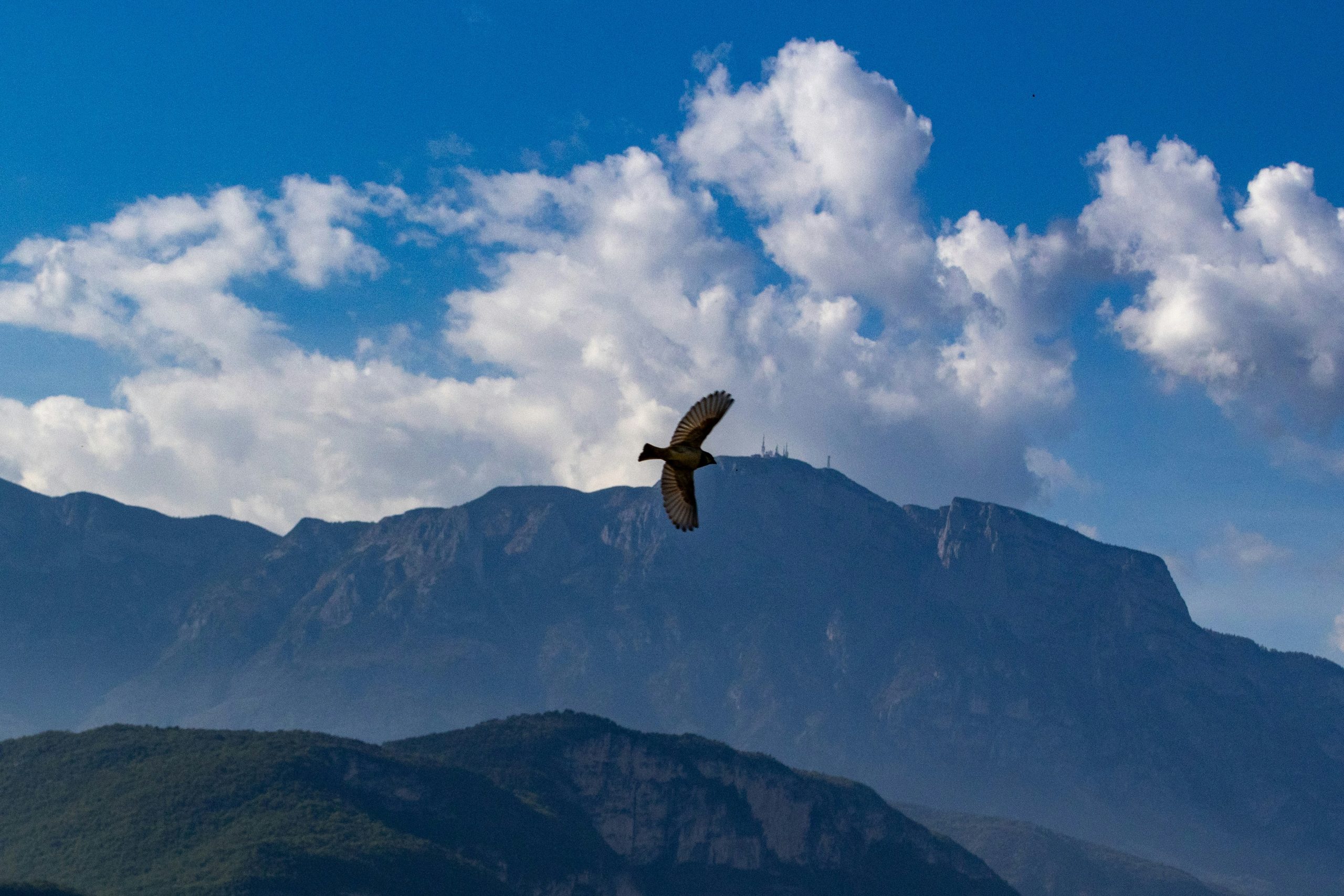
Large birds can use rising columns of warm air, known as thermals, to gain altitude without continuously flapping their wings. These currents form when the Sun heats the ground unevenly, causing warmer air to rise.
Once an eagle reaches a suitable height, it can glide toward another rising current and repeat the process.
Mountain slopes can provide another source of lift. Wind moving upward along a ridge creates conditions that soaring birds can use to remain airborne.
A scientific study of migrating golden eagles in eastern North America analyzed more than 22,000 tracking locations from 32 birds. Researchers found that the eagles relied heavily on assisted flight, using thermal currents, gliding, and rising air near terrain features during migration. https://pubmed.ncbi.nlm.nih.gov/26538556/
These techniques help explain how large birds can cover substantial distances while conserving energy.
Real Research Shows What GPS Tracking Can Achieve
Although the story of a single eagle being tracked for more than 20 years cannot be confirmed from the information available, published research demonstrates that scientists have successfully monitored eagles over multiple years.
A 2023 study published in Royal Society Open Science examined the use of GPS tracking to monitor martial eagles in South Africa’s Kruger National Park.
Researchers fitted 14 adult martial eagles with GPS transmitters between 2012 and 2020. The devices helped the team identify potential nest locations and assess breeding activity.
