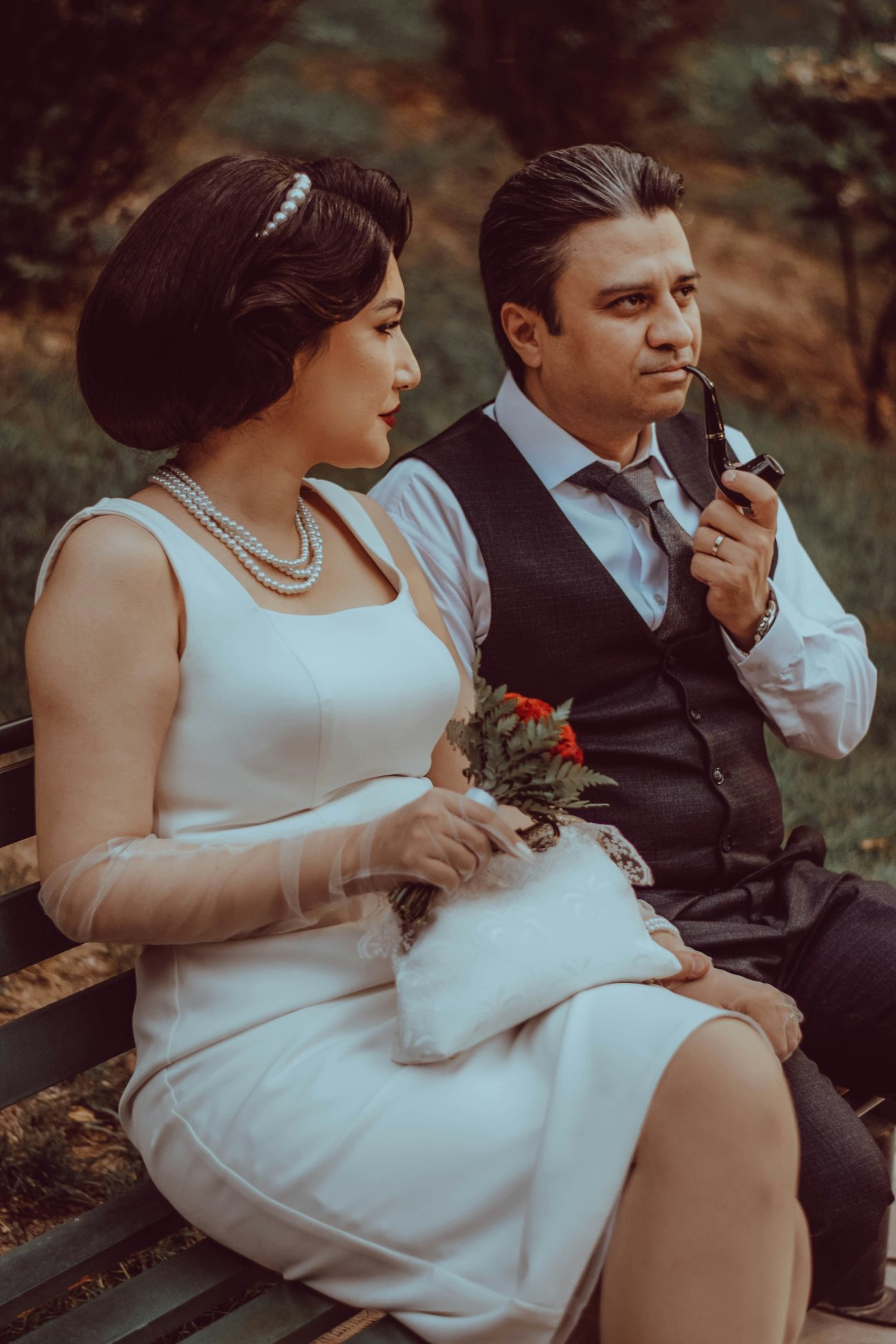
The discussion becomes part of the photograph’s appeal.
People enjoy testing their own observations against what others see.
And because everyone approaches an image with slightly different expectations and experiences, the conversation can continue long after the photograph first appeared.
Looking Beyond the First Impression
Returning to the photograph, the most interesting aspect is how its different visual elements interact.
The dark jacket and white shirt create contrast. The pale purple gown introduces softer tones and folds of fabric. The red curtain provides a bold background, while the metallic decoration adds reflective highlights.
The close positioning of the two individuals creates overlapping shapes around their clothing and arms.
None of these features is necessarily unusual on its own.
Together, however, they produce a composition that rewards closer attention.
A viewer who glances at the picture for only a second may see a simple formal portrait. Someone who spends more time examining it may begin noticing the details that make the image distinctive.
That is part of the pleasure of looking at historical photography.
It gives us a reason to slow down.
Instead of immediately deciding what an image means, we can observe the clothing, surroundings, lighting, and positioning of the subjects.
We can appreciate the craftsmanship of older photography and consider how a single camera angle preserved a moment that can never be recreated in precisely the same way.
Final Thoughts
Historical photographs continue to fascinate people because they preserve more than faces and events. They capture the visual details of everyday life, including fashion, decorations, surroundings, and the small moments that might otherwise have been forgotten.
This photograph is an example of how an ordinary-looking scene can become interesting through its composition.
The two formally dressed individuals, the contrasting colors, the folds of the gown, the red curtain, and the reflective metallic decoration all contribute to the image’s distinctive appearance.
Its unusual visual effect also reminds us that photographs don’t always communicate everything as clearly as we might expect.
Camera angles, lighting, perspective, and overlapping shapes can influence how viewers interpret what they see.
And sometimes, the best way to appreciate an unusual photograph is simply to look again.
Not every surprising detail hides a secret. Not every strange-looking image has been manipulated. Sometimes, an ordinary moment becomes memorable because the camera happened to capture it from just the right angle.
That is what makes photography so fascinating: a single frame can preserve a moment from the past and still give people something new to notice years later.
