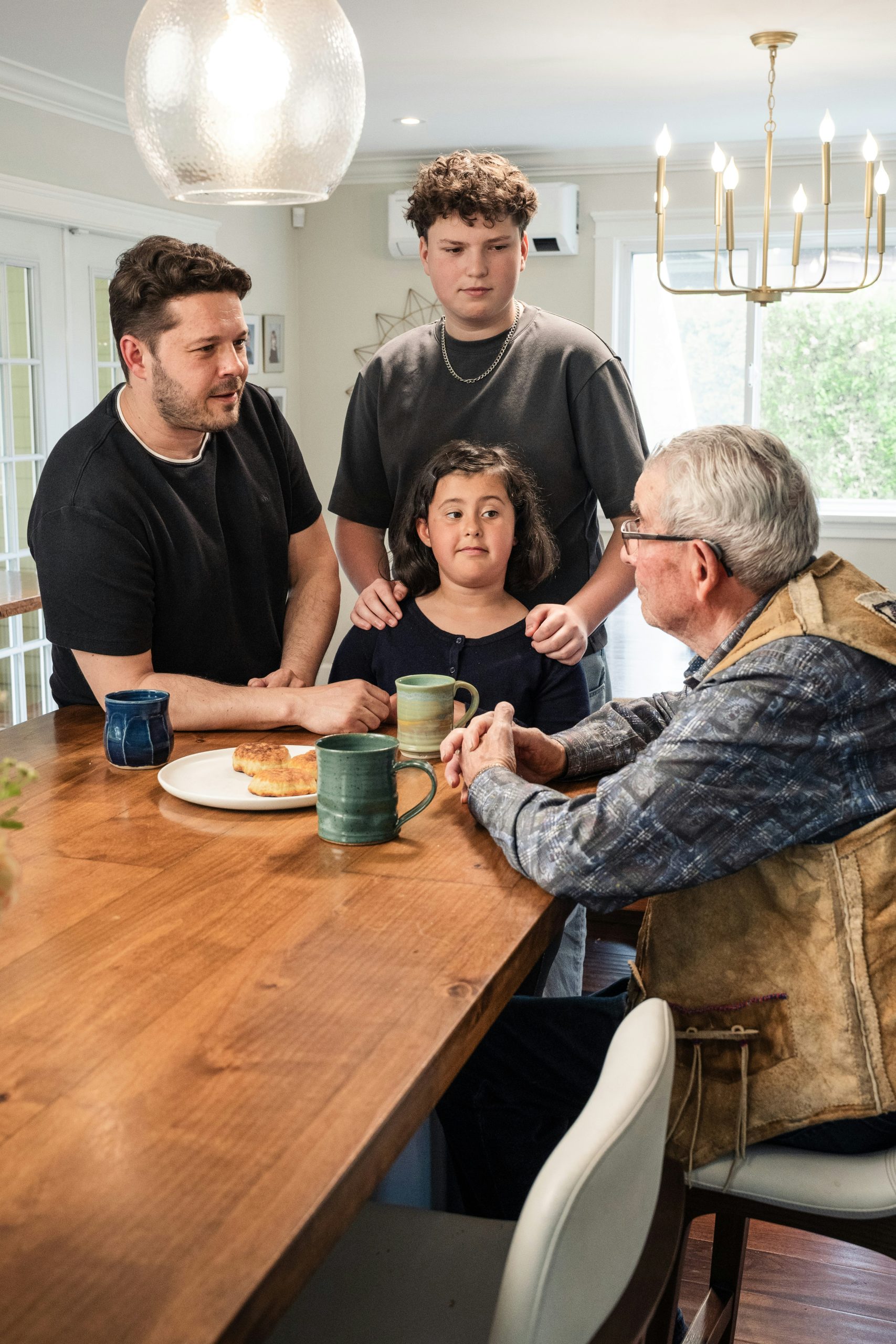
She spoke about the Braille labels, the kitchen routines, and the small things her fathers had done to help her become more independent.
Those were her real memories.
They were not dramatic scenes created for television. They were years of everyday care, patience, and support.
As Claire listened, she began to understand that the story presented by Grant’s representatives did not match the family’s account.
The documentary had been built around a version of events that Willa herself did not recognize.
Then Willa asked the question she had been waiting to ask.
Why had Grant not come for her when she was young?
Why He Had Stayed Away
Grant admitted that he had been at the beginning of his acting career when he learned about Willa’s blindness.
He said he had felt unprepared to take responsibility for raising a child with additional needs.
For Willa, the explanation was painful, even if it answered part of what she had wondered about for years.
She had grown up without knowing why her biological father was absent. Now she was hearing that he had believed he could not handle the responsibilities of parenting her.
She did not need to shout or argue to make her feelings clear.
She explained that his decision had affected her. She had spent years wondering whether there was something about her that made him leave.
Now, after building a life with Nathan and Reid, she found herself facing a man who appeared interested in reconnecting at a time when a documentary could benefit his public image.
She questioned why the relationship had to begin with a media project and a financial arrangement.
Grant listened.
He asked whether they might be able to speak again privately.
Willa did not completely close the door.
She said that perhaps they could have a conversation someday, but she was not willing to make their first meeting part of a television production.
She also made clear that any future relationship would have to develop naturally, without money or publicity influencing her decisions.
Grant asked whether he could leave his contact information.
Willa agreed that he could give it to Nathan and Reid. If she ever wanted to contact him, she would make that choice herself.
Then she ended the meeting.
The Documentary Was Put on Hold
A few weeks later, Claire contacted the family with an update.
The production company would not proceed with the documentary in its proposed form.
The information supplied by Grant’s representatives needed to be reconsidered, and the company could not continue using a family narrative that had not been properly verified.
For Nathan and Reid, the decision was reassuring.
They had been concerned that Willa’s childhood might be turned into a public story that misrepresented the people who had actually raised her.
For Willa, it meant that her boundaries had been respected, at least in this particular situation.
Grant later sent her a message asking whether she might be interested in having a private conversation.
She decided she was not ready.
Her fathers supported her without trying to change her mind.
They understood that reconnecting with a biological parent is not a simple decision, especially when that parent was absent during childhood. Willa did not owe Grant an immediate relationship simply because he had finally appeared.
Nor did she have to reject him forever to prove her loyalty to the people who had raised her.
She could take her time.
The Meaning of Being a Parent
Willa’s story raises an important question about what makes someone a parent.
Biology can establish a connection, but it does not automatically create trust, familiarity, or a lasting relationship. Those things develop through presence and responsibility.
Nathan and Reid had spent twelve years showing Willa that she could depend on them. They had helped her through ordinary childhood challenges, encouraged her independence, and made sure she knew that her needs were never a burden.
Their family had faced judgment from people who questioned whether they could provide the right home. Yet the most meaningful evidence of their parenting was not found in arguments with critics or declarations about family values.
It was found in the everyday life they had built together.
Grant’s return raised complicated questions that Willa may continue to consider as she grows older. She may eventually want to learn more about her biological family. She may decide to speak with him, ask further questions, or establish some kind of relationship.
Those decisions belong to her.
What matters is that she now has the confidence to make them without feeling pressured by money, public attention, or someone else’s expectations.
A biological connection may explain where a person comes from. But the people who show up, offer stability, and remain present through the difficult years help shape what home means.
For Willa, that home was built long before Grant knocked on the door.
