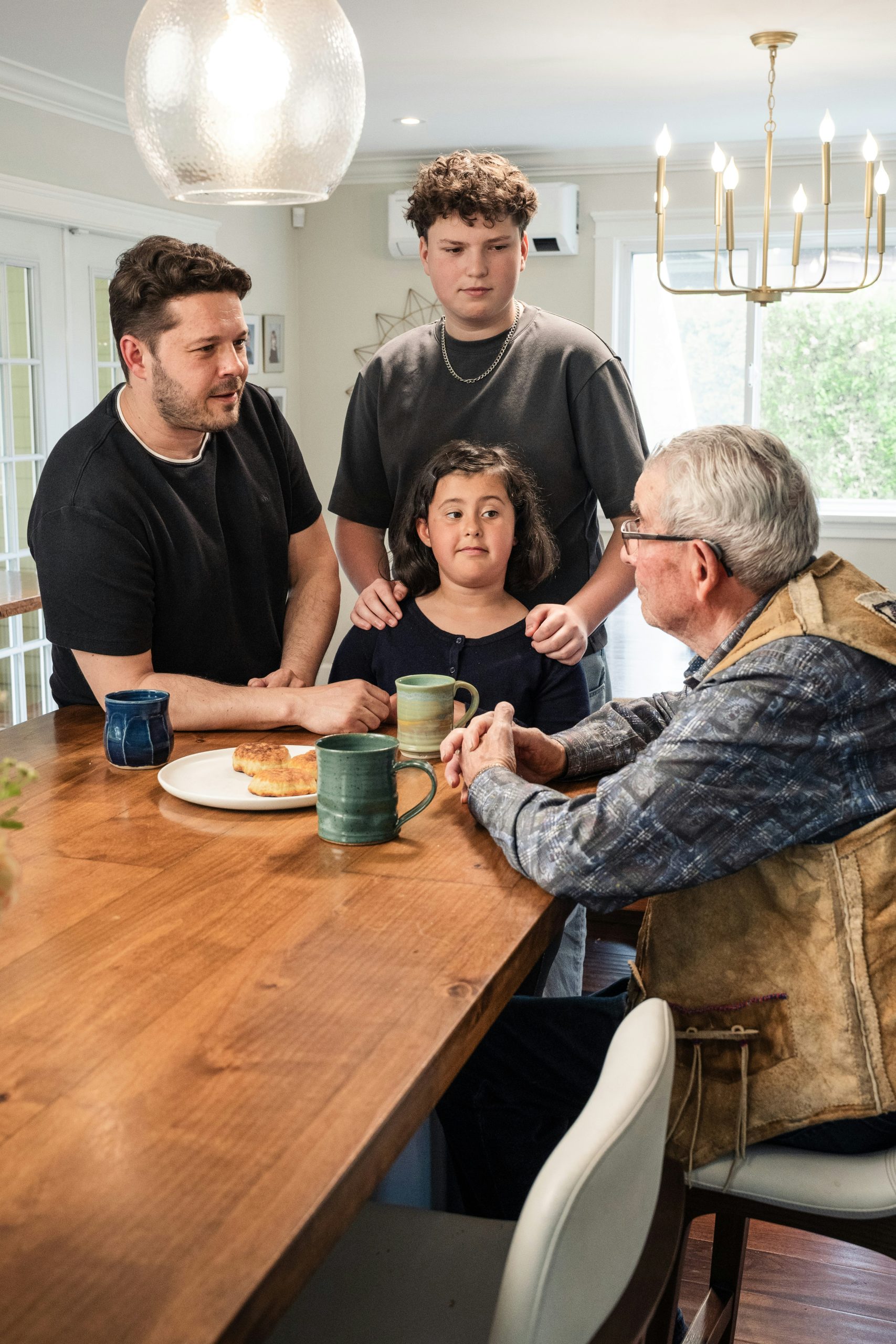
Reid learned to braid her hair, even though his first attempts were far from perfect. Nathan worked on making their kitchen easier for her to navigate, labeling containers in Braille and arranging frequently used items in consistent locations.
They also encouraged her to explore activities that interested her rather than allowing her blindness to define what she could or could not do.
Baking quickly became one of her favorite hobbies.
She learned to recognize ingredients, follow recipes, and become familiar with the kitchen through touch, organization, and practice. Her fathers helped when necessary but were careful not to take over tasks she wanted to handle herself.
That balance became an important part of their parenting.
They understood that protecting Willa did not mean preventing her from taking reasonable risks or learning through experience. It meant giving her the support and confidence to make her own decisions.
By sixteen, she was no longer the little girl who held tightly to Nathan’s sleeve whenever he moved away.
She had developed her own sense of humor, enjoyed challenging her fathers over household rules, and was comfortable expressing what she wanted.
Nathan and Reid were proud of the person she was becoming.
They also ran a successful neighborhood bakery and café. The business had become an important part of their lives, and they had begun considering ways to expand it. Finding the right financial support, however, had proved more difficult than expected.
They were still working through those plans when Willa’s sixteenth birthday arrived.
Neither father had any reason to believe that the celebration would become a turning point in their family.
A Famous Actor Appears at Their Door
The family was preparing Willa’s favorite meal when someone knocked.
Nathan went to answer the door, expecting a guest or perhaps a delivery.
Instead, he found a man whose face he recognized.
It was Grant, a well-known actor.
After introducing himself, Grant explained that he was Willa’s biological father.
Nathan was stunned.
The adoption records available to him and Reid had not revealed Grant’s identity, so neither father had expected to encounter the man who had been part of their daughter’s earliest history.
Grant said he had recently become interested in reconnecting with Willa. He spoke about wanting to support her education, help financially, and provide opportunities that might make her future easier.
On the surface, those offers could have sounded generous.
But Grant soon made a request that changed the atmosphere.
He wanted Willa to move into his home.
Reid questioned why such a major change would be necessary, particularly when Willa had spent twelve years building a stable life with her adoptive parents.
Grant explained that he was working on a documentary about his life and wanted his daughter to participate.
He had already presented a version of their family history to the production team.
According to the proposed story, Grant had remained an important presence throughout Willa’s childhood. The documentary would include interviews and prepared answers describing experiences that had never taken place.
Nathan found the idea deeply troubling.
The script reportedly included scenes of Grant teaching Willa how to navigate a kitchen. Yet he had not been there when she learned those skills. He had not helped her through the difficult early years, and he had not been present for the ordinary moments that made up her childhood.
The story being prepared for the cameras was not the story Willa had lived.
The $3 Million Offer Came With Conditions
Grant eventually explained another part of his visit.
He had learned about Nathan and Reid’s plans to expand their bakery and café. He offered them approximately $3 million to help finance the project.
