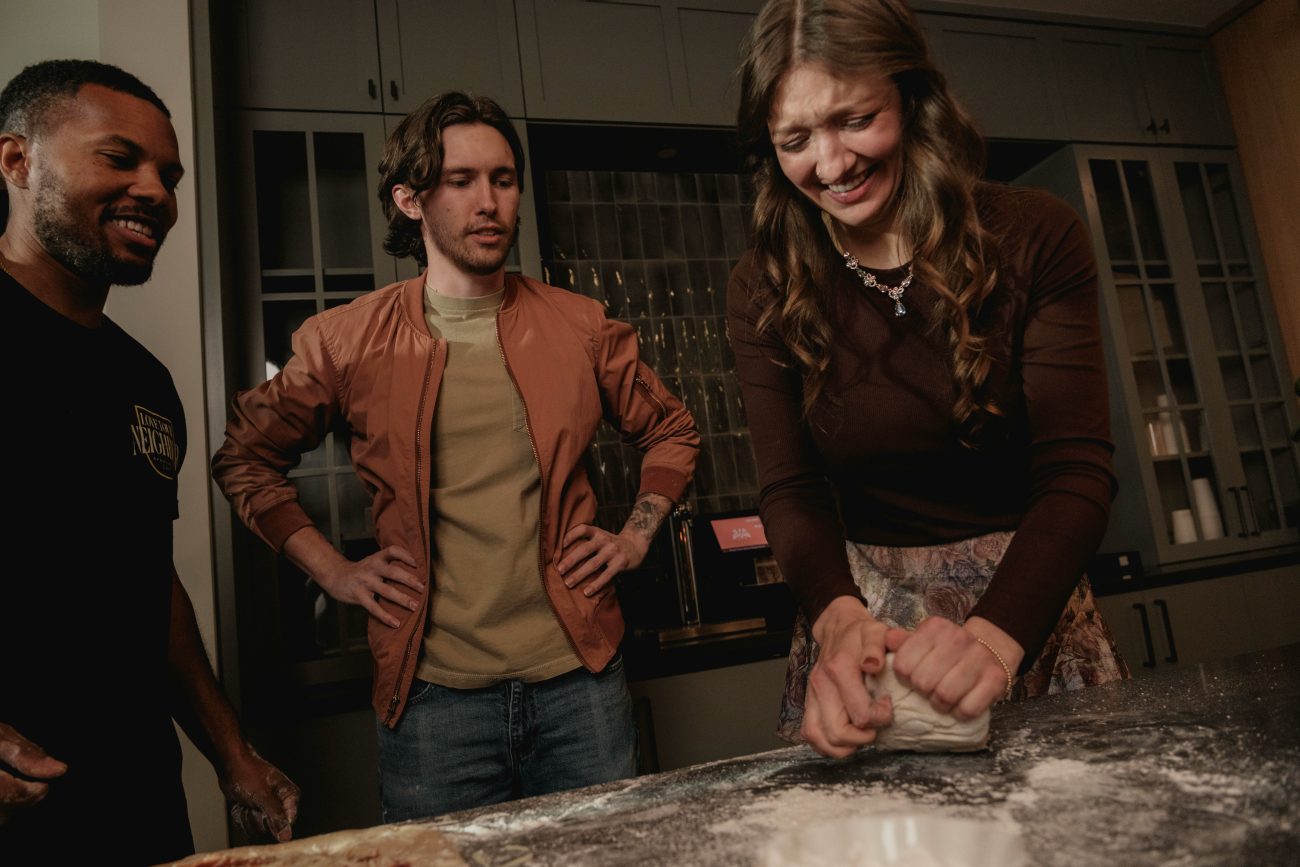
One afternoon, Nathan was reviewing expansion documents when Willa entered the room.
She asked whether he regretted turning down the opportunity.
Nathan explained that no business opportunity could justify making decisions about her life without her consent.
Willa seemed relieved.
She told him she was grateful that her fathers had allowed her to speak for herself rather than deciding everything on her behalf.
Then she returned to the kitchen to prepare another batch of her favorite frosting.
By this point, baking had become one of her favorite activities. She knew where the ingredients were, understood how to organize the workspace, and had developed her own routine.
She measured everything confidently and jokingly told Nathan to leave because she no longer needed supervision.
Before he walked away, she asked him to return in 20 minutes to taste the finished recipe.
Nathan smiled and promised he would.
It was an ordinary family moment, but it carried a meaning that no documentary could have recreated.
He remembered the little girl who once held tightly to his sleeve because she was afraid he might disappear.
Now she was a confident young woman who knew she could make decisions for herself and trust that her family would respect them.
What Makes Someone a Parent?
Willa’s experience raises a question that goes beyond biology: What does it actually mean to be a parent?
Biological relationships can be important. Many adopted children want to understand their origins, learn about their biological relatives, or establish contact with them as adults.
Those feelings deserve respect.
But biological connection alone does not describe the daily work of raising a child.
Parenthood also involves showing up consistently, providing care, listening, offering reassurance, and helping a young person develop confidence.
Nathan and Reid had been part of Willa’s everyday life for 12 years.
They had supported her through childhood, helped her navigate the world as a blind person, and encouraged her to become increasingly independent.
They were there for the small moments that rarely make dramatic stories: preparing breakfast, practicing new skills, solving ordinary problems, and helping her feel comfortable asking for what she needed.
Grant’s return did not erase those experiences.
Nor did Willa have to reject her biological history to appreciate the family that raised her.
She could be curious about where she came from while remaining grateful for the people who had given her a home.
Most importantly, she had the right to decide what kind of relationship, if any, she wanted with her biological father.
The Right to Tell Her Own Story
Perhaps the most important moment in the entire experience was not Grant’s arrival or the $3 million offer.
It was Willa’s decision to speak for herself.
She refused to allow someone else to turn her childhood into a convenient story. She corrected the memories that had been invented for the documentary and explained what her real life had been like.
She also made it clear that her blindness was not a reason to treat her as helpless or to use her experiences as a dramatic device.
She was a teenager with her own opinions, boundaries, interests, and ambitions.
Her fathers had spent years helping her develop independence. When the most important decision of her young life arrived, they allowed her to exercise it.
And that may have been the clearest expression of their love.
Willa did not need a wealthy biological father to prove that she had a future. She did not need to appear in a documentary to validate her childhood. She already had a family that valued her beyond what she could offer anyone else.
Nathan and Reid had not built their family around money, public approval, or the opinions of strangers.
They had built it around love and responsibility.
