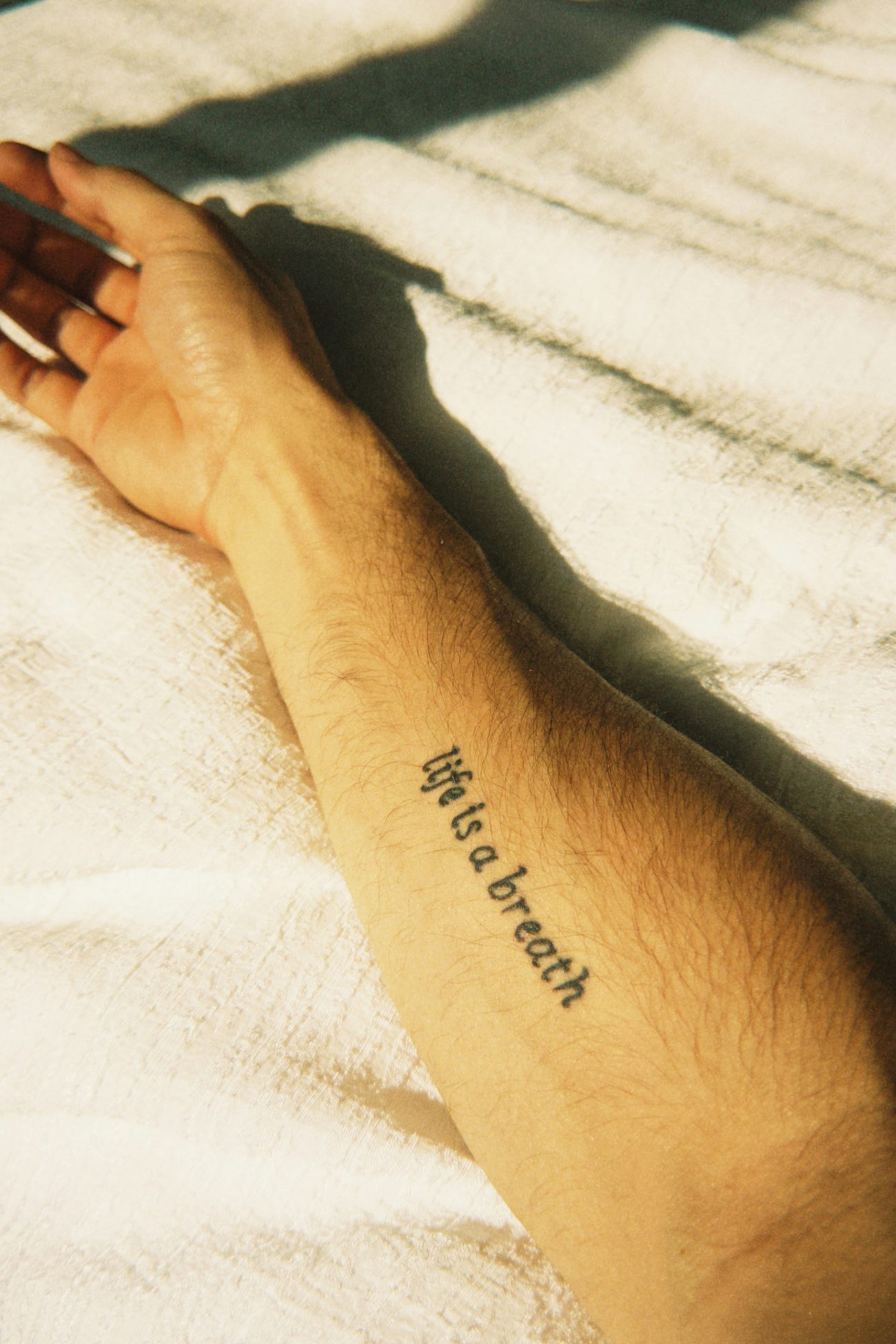
The quality of the image can also affect interpretation. A photograph taken from an awkward angle, reduced in resolution, or displayed on a small screen may make certain details difficult to distinguish.
For that reason, different interpretations of an online image should not automatically be treated as proof of its intended meaning. Without a clear view of the original tattoo or an explanation from the artist or wearer, some uncertainty may remain.
How Typography Can Turn Ordinary Words Into a Visual Puzzle
Typography is the art and technique of arranging letters and text. It influences how words look, how easily they can be read, and the impression they create.
It is used everywhere, from book covers and advertisements to business logos, websites, posters, and product packaging.
Although readability is important in most everyday typography, artists and designers sometimes use lettering in ways that deliberately challenge conventional reading habits.
Words can be arranged in circles, reflected like mirror images, rotated, stacked, or combined into patterns. Letters may overlap or share parts of a design, creating an image that looks more like artwork than ordinary writing.
A phrase might initially resemble a decorative symbol. Only after examining the individual elements does the viewer begin to recognize the words.
This approach can make even a short message visually distinctive.
Why the human body creates additional design challenges
Tattoo lettering introduces another consideration: the surface on which the design will appear.
Unlike a printed page or digital image, skin is not a flat, stationary canvas. The body has curves, contours, and areas that move whenever someone bends an arm, turns a shoulder, or changes position.
A lettering design placed on an arm may look different depending on whether the arm is straight, bent, or rotated. A design on the shoulder or wrist may also need to be viewed from a particular angle to make its arrangement clear.
Tattoo artists must consider these physical details when planning a design.
For an optical or hidden-message tattoo, precision can be especially important. If the lettering depends on a particular alignment, even small changes in spacing or placement may affect the intended visual effect.
The result is a form of body art that combines graphic design with the practical challenges of working on a three-dimensional surface.
Why Visual Puzzles Become Popular on Social Media
Social media encourages people to react, comment, share, and participate. That is one reason photographs containing unusual details or hidden patterns can generate so much discussion.
A conventional photograph may attract attention because it shows something beautiful, surprising, or unusual. A visual puzzle offers something additional: an invitation to solve it.
People may zoom in, compare interpretations, ask friends what they see, or return to the image after reading someone else’s explanation.
That interaction can help a simple picture travel far beyond its original audience.
Optical illusions are particularly effective because viewers do not always notice the same things at the same time. A hidden shape may be obvious to one person but difficult for another to identify.
Unusual lettering can create a similar experience. When someone believes they have discovered the message, they may feel compelled to share the answer or challenge someone else to find it.
However, online popularity does not necessarily establish that a particular interpretation is correct. Images are frequently reposted without their original context, and explanations can become separated from the artwork they describe.
In the case of this tattoo, the visual arrangement is the main point of interest. Without a confirmed explanation from the person who created or wears it, claims about its exact meaning should be treated cautiously.
Tattoos Are About More Than Their Appearance
Although unusual lettering can attract attention because of its visual effect, tattoos have a much broader role in personal expression.
