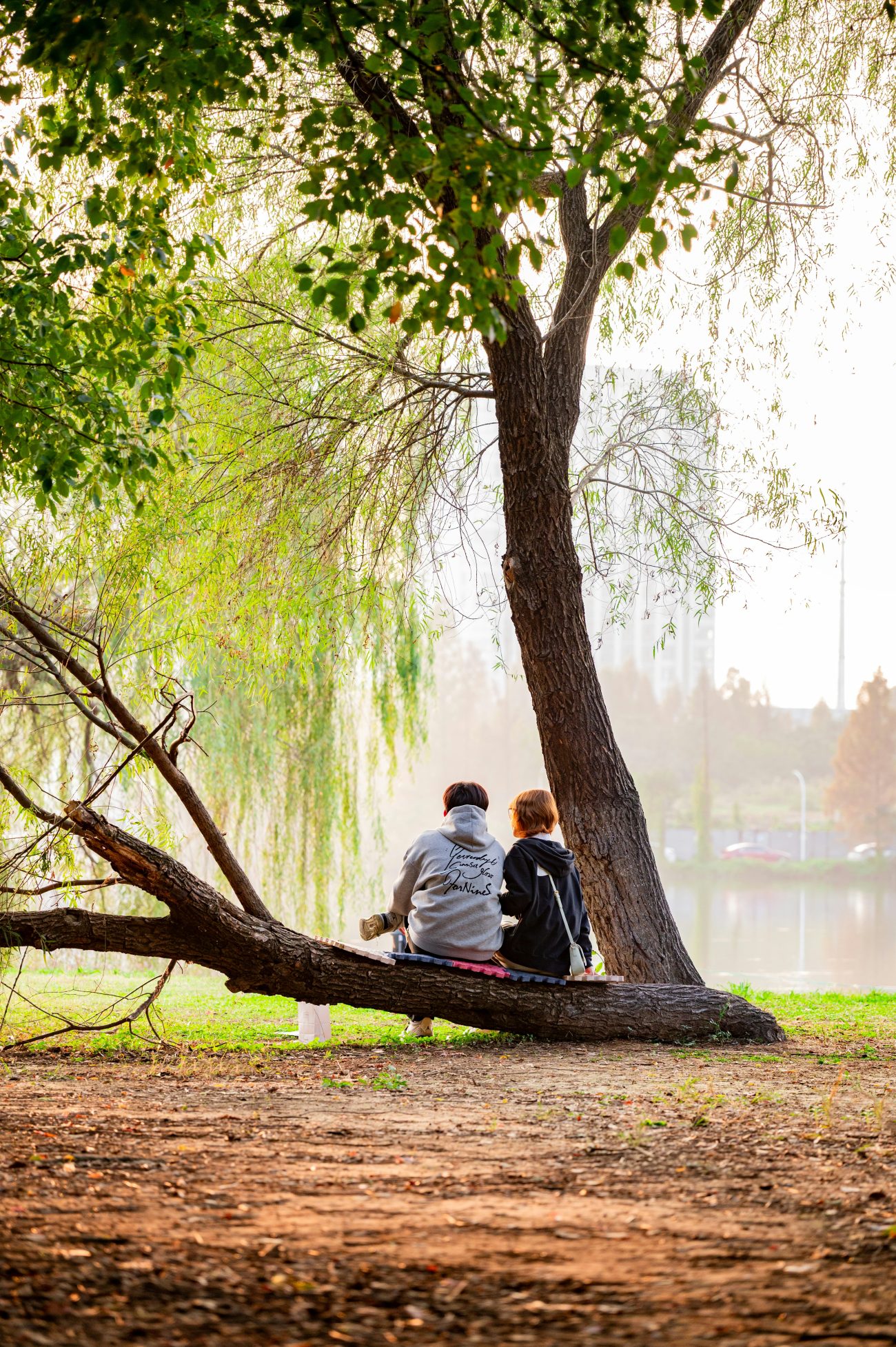
I showed him the photograph of us beneath the tree.
He looked at it for a long time.
Then he looked at me.
There was no sudden recognition, no dramatic declaration. He simply seemed to be studying something that felt familiar without knowing why.
I didn’t push him.
We stayed for a little while, then returned to the care home.
I kept the photograph in my bag.
For the next year, I thought about that afternoon often.
The Moment Beneath the Willow Tree
The following June, Benjamin’s health had become more fragile.
The staff explained that outings needed to be shorter, and I agreed to follow their guidance.
Still, I wanted him to see the willow tree again if it was possible.
We arranged another visit.
The sky was clear, and the leaves moved gently above us.
I placed the red carnations beside the roots.
Benjamin sat quietly in his chair.
I began telling him about the summer we had met.
I described the bicycle chain, the repair shop, and the first time he walked me home.
I told him about the ring.
Then I took the old photograph from my bag.
“Look,” I said softly. “This is us.”
He looked at the picture.
For a long time, nothing happened.
Then his eyes moved from the photograph to my face.
He studied me with an expression I had not seen before.
“Margaret?” he whispered.
My breath caught.
“Yes, Benjamin. It’s me.”
He looked at my dress.
“You wore blue.”
I began to cry.
“Yes. I wore blue that day.”
He reached toward my hand.
I took it gently.
“The tree,” he said.
“Yes. Our willow tree.”
He looked around, then back at me.
“I promised I’d come back.”
I could barely speak.
“You did.”
He held my hand a little more firmly.
“I tried.”
Those two words carried more emotion than I could ever explain.
I had spent decades wondering whether he had forgotten me, whether he had thought of me during the years when I believed him dead, and whether he had ever known that I was still waiting.
I did not know how much he remembered or how long the moment would last.
I didn’t ask.
I simply held his hand.
For a brief time, beneath the same branches where we had once imagined our future, Benjamin knew who I was.
He remembered my name.
He remembered the blue dress.
He remembered the promise.
And that was enough.
The Last Days
After that afternoon, Benjamin’s condition continued to decline.
His good days became less frequent. He slept more, ate less, and sometimes seemed uncomfortable even when the staff had done everything they could to help him.
I visited whenever I was able.
I learned to recognize the signs that he needed rest. I spoke softly and allowed the nurses to guide me when he needed medical attention or a change in routine.
I no longer expected him to recognize me.
But I still told him I was there.
I read from the books he had once enjoyed. I played familiar music when the staff said it was appropriate. I spoke about the willow tree and the red carnations.
Sometimes I held his hand.
Sometimes I simply sat beside him.
One afternoon, Helen told me that Benjamin’s health had changed significantly.
The care team was focusing on his comfort and making sure he was not in pain.
I thanked her for telling me.
I went home that evening and took the little silver ring from its box.
I held it in my palm for a long time.
It had become worn over the years, and the stone was no longer as bright as it had once been. But I remembered the young man who had placed it on my finger and asked me to wait.
