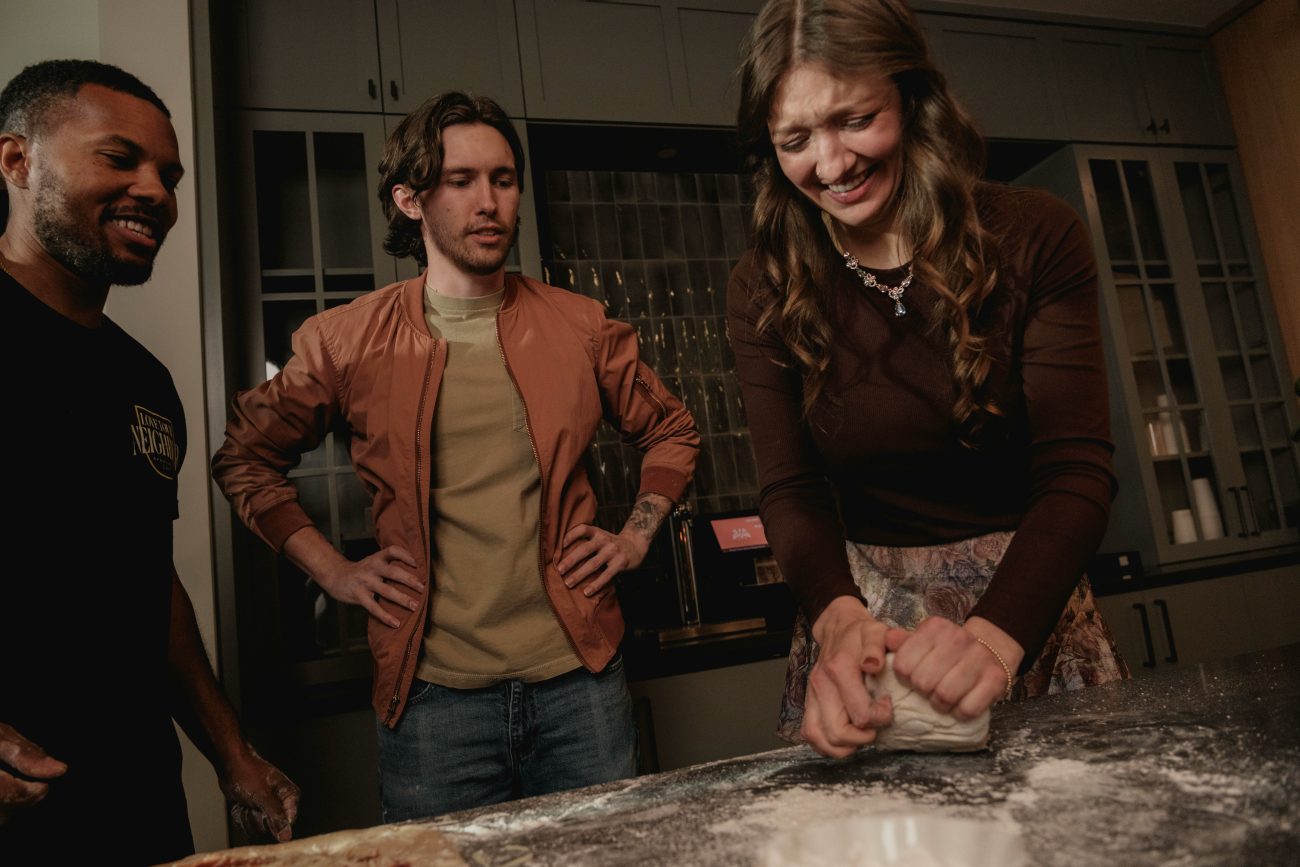
Her blindness was part of her experience, but it did not define everything she could accomplish.
By the time she turned 16, she was a confident teenager who enjoyed joking with her fathers, negotiating her curfew, and trying new recipes.
Nathan and Reid were proud of the independent young woman she was becoming.
Their family was not perfect, but it was built on affection, communication, and the belief that Willa belonged.
The Actor Who Appeared at Their Front Door
Nathan and Reid also owned a successful neighborhood bakery and café.
The business had become an important part of their lives, and they were considering expanding it. They had customers, a recognizable local presence, and plans for the future, although securing enough financing remained a challenge.
Then came Willa’s 16th birthday.
The family was preparing her favorite meal when someone knocked on the door.
Nathan answered and immediately recognized the visitor.
It was Grant, a well-known actor.
After introducing himself, Grant revealed that he was Willa’s biological father.
Nathan was stunned.
Neither he nor Reid had known his identity. The adoption records available to them had not provided the information, and Grant had not been part of Willa’s life since she was a young child.
Grant explained that he had recently become interested in reconnecting with his daughter.
He spoke about wanting to support her education, help secure her future, and give her opportunities that might otherwise be difficult to access.
Those offers could have sounded generous under different circumstances.
But Grant quickly introduced another subject.
He was developing a documentary about his life and wanted Willa to participate.
He also wanted her to move into his home, at least temporarily.
Nathan and Reid were immediately uncomfortable.
They had no intention of preventing Willa from learning about her biological family, but they wanted to understand why Grant was making these requests now and what he expected from their daughter.
As they listened, their concerns became more serious.
The Documentary That Told a Childhood Willa Never Had
Grant explained that his production team had already developed a concept for the documentary.
The project would present him as a father who had remained deeply connected to his daughter’s upbringing and had played an important role in shaping her life.
But the proposed script included memories that Willa could not possibly have shared with him.
One particularly disturbing example involved scenes describing Grant teaching her how to navigate a kitchen.
In reality, he had not been there when Nathan and Reid adapted their kitchen to help her become more independent.
He had not helped her learn to bake, guided her through childhood milestones, or reassured her when she was frightened.
Those experiences belonged to the family that had raised her.
When Nathan and Reid questioned the script, Grant suggested that certain details could be adjusted.
But the problem went beyond a few inaccurate scenes.
The documentary appeared to be presenting a version of their family history that did not reflect what had actually happened.
Willa’s childhood was not a fictional storyline that could be rewritten to suit a production.
It was her life.
Nathan was particularly troubled by the possibility that the project would use his daughter’s blindness and early experiences in foster care to create an emotional narrative centered on Grant.
Reid agreed.
They wanted Willa to have the freedom to decide whether she wished to meet her biological father. They did not want her pressured into performing a role in a documentary.
Then Grant revealed another part of his proposal.
The $3 Million Offer Came With Conditions
Grant knew about Nathan and Reid’s bakery.
