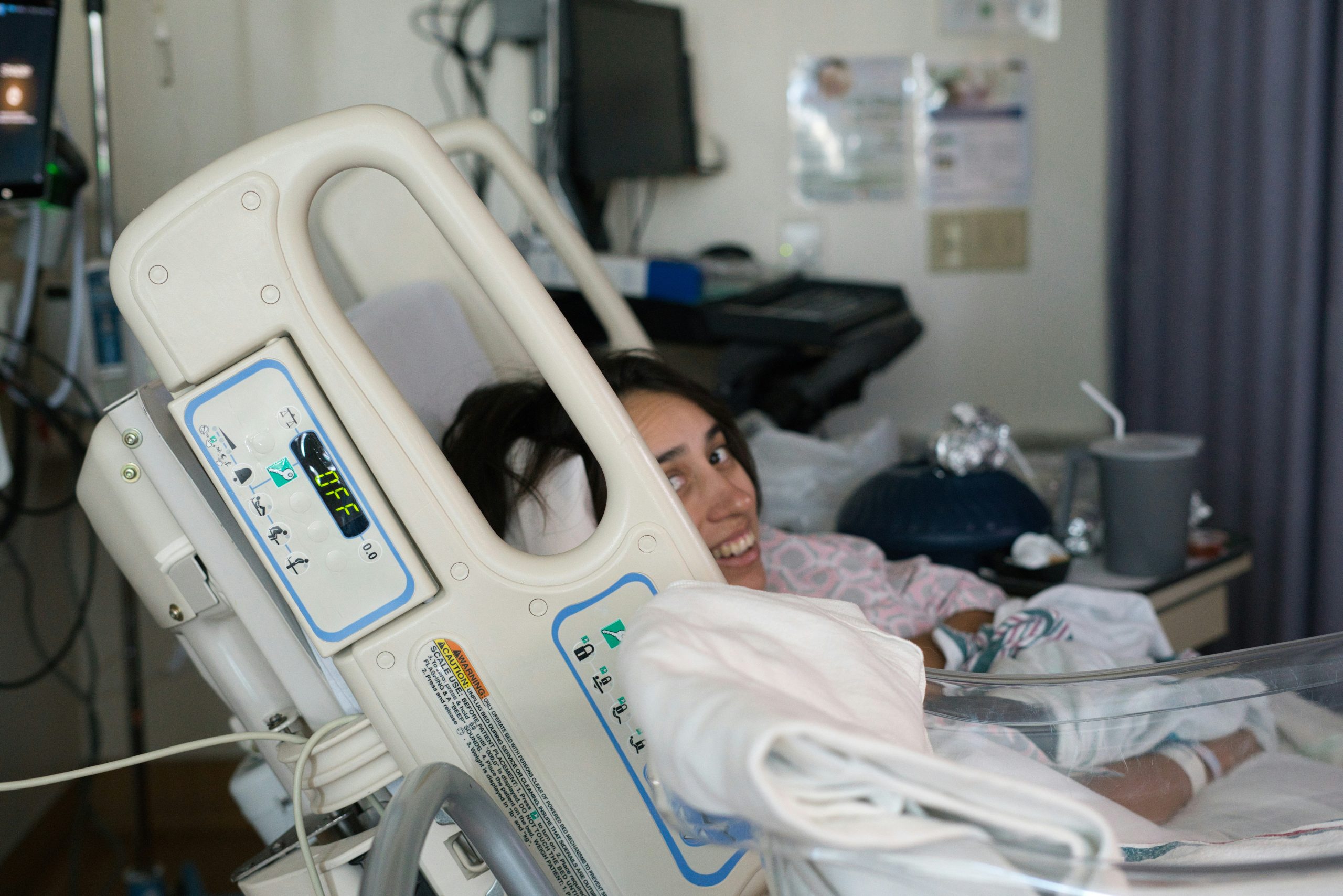
But I knew one thing: I could no longer spend my energy waiting for someone who had already shown me how little he valued us.
Whatever happened with Daniel would have to be dealt with eventually. For now, my responsibility was the little girl sleeping beside me.
The Morning I Was Finally Ready to Say Thank You
On the morning of my discharge, I began gathering the few belongings I had brought to the hospital.
The flowers were still beside my bed. Their white petals reminded me of the note that had made me cry, and I found myself reading it once more.
Michael had not known my mother. He had not known about my husband’s affair or the months of loneliness that had brought me to that hospital room.
He had simply seen a frightened woman who needed help.
And he had helped her.
I wanted him to know what that small act had meant to me. I also wanted to thank him for returning with the flowers when he could have forgotten about the entire experience and gone on with his day.
I approached the hospital receptionist and asked whether there was a way to contact the taxi driver.
She kindly helped me call the company.
A woman answered.
“Good morning, City Taxi.”
“Hello. I’m trying to reach a driver named Michael. He brought me to the hospital a few nights ago.”
There was a brief pause.
“Do you mean the driver who brought in a woman who was about to give birth?”
My eyes filled with tears again.
“Yes. That’s me.”
“Oh, of course. I remember him mentioning that he wanted to check whether you and the baby were doing well. Is everything okay?”
I looked down at Grace, sleeping peacefully in her carrier.
“Yes. We’re both doing well. I just wanted to thank him.”
The woman sounded pleased.
“That’s very kind of you. Let me see if I can help you get in touch with him.”
The account ends at this point, just as the mother begins trying to contact Michael. It does not reveal whether they speak again, whether he receives her thanks, or what happens next.
Why a Stranger’s Kindness Can Stay With Us
The most memorable part of this account is not the bouquet itself. It is the thought behind it.
Michael had no obligation to return to the hospital. His responsibility as a taxi driver could have ended when he safely delivered his passenger to the entrance. Yet he remembered her, wondered how she and her baby were doing, and made the effort to send a personal message.
His note also revealed something about his own life. He and his wife had spent twelve years hoping to become parents. That experience did not make him resentful toward someone who had just welcomed a child. Instead, it appeared to deepen his compassion.
He understood that people can be carrying private struggles that are invisible to everyone around them.
A woman sitting quietly in the back of a taxi might be frightened, grieving, or facing circumstances no stranger could possibly imagine. A simple gesture of patience can mean more than the person offering it realizes.
There is another important part of this story: kindness does not always require grand gestures.
Michael did not promise to solve the mother’s problems. He did not pretend to understand every detail of her situation. He simply stayed with her when she needed support, then sent flowers to let her know she had nothing to apologize for.
Sometimes, that is enough to make someone feel seen.
For the new mother, the flowers arrived at a moment when she was questioning what kind of future she and her daughter could have. They did not change the past, but they offered a reminder that her experience was not defined entirely by betrayal and loss.
